|
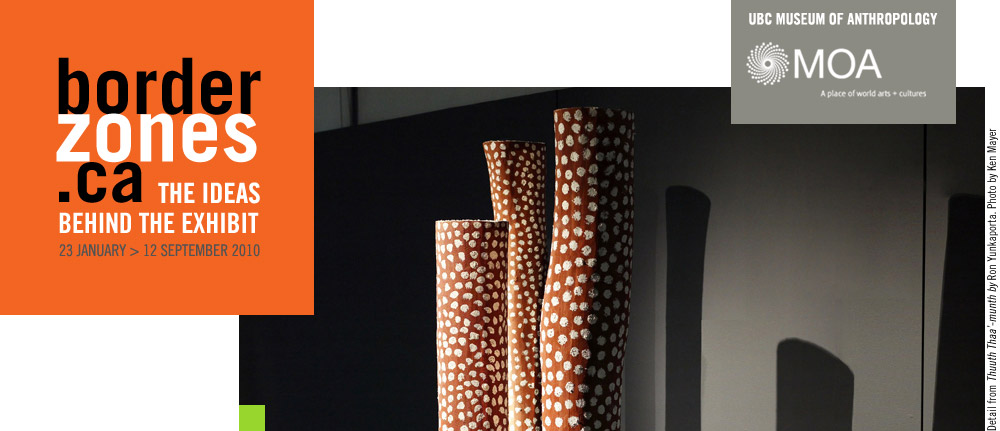
Yunkaporta began creating sculptures for exhibition around 1995
and several of his Law Poles have been presented in exhibitions
in Australia as well as being acquired by the Aboriginal Art Museum
in Utrecht, in the Netherlands. These vary only slightly, with the
occasional addition of two or three bands of string, wrapped around
the top, from which white ibis feathers protrude. His other works
include wood carvings of totemic animals such as sharks and dugong,
a large marine mammal found in the shallow coastal waters of northern
Australia, and an ancestral figure, Father Apelech. All are linked
to the Saltwater Country for which he has custodial responsibilities
and are painted as the poles are, with a red ground and white spots.
The presence of these ceremonial poles in art museums reflects
a recent change in perceptions by both viewers and artists. Wider
acceptance and appreciation of Aboriginal aesthetics have transformed
these objects from ethnographic artifacts to modern art works. While
Aboriginal cultural practices and artifacts have been of interest
to anthropologists and museum collectors since the late nineteenth
century, they have only gained global recognition as art since the
1970s when Western Desert acrylic paintings began to be produced
commercially. These are probably the most widely recognized form
of Indigenous Australian art, their colorful, symbolic designs depicting
Dreaming stories and events using motifs adapted from ceremonial
ground and body paintings. Similarly, in Arnhem Land, artists produce
intricately painted bark paintings and hollow log mortuary poles
whose surfaces are covered with finely painted cross-hatching, diamonds
and other patterns that represent the clans, waters, creatures and
ancestral beings of the saltwater regions of the Northern Territory.
These have attracted critical acclaim as well as a number of national
Indigenous art awards, and are sought after by private art collectors
and galleries. However, it is only in the past decade or so that
indigenous art works from northern Queensland – Lockhart River,
Mornington Island, Bentinck Island, Aurukun – have gained
attention in the art world.
Despite their new role, the poles continue to hold sacred power.
When he sends Law Poles to galleries in distant locations, Yunkaporta
records stories and songs to accompany them. This provides protection
for those who view and handle them, who might otherwise become sick,
and also gives visitors some sense of context and meaning.
While the production and display of Law Poles continues an age-old
practice, the commodification of ritual sculptures, bark paintings
and Western Desert acrylic paintings can be seen as a part of an
on-going strategy by Indigenous artists to use Aboriginal art to
reach out to non-Indigenous audiences and draw attention to Aboriginal
cultural and political interests. In producing these works, artists
are asserting their cultural identity, status and custodial responsibilities
through the display of cultural artifacts and the symbolic meanings
conveyed in the patterns. When viewed by non-Indigenous audiences,
much of this meaning may be ‘hidden in plain view’ due
to the unfamiliarity of the iconography and symbolism. Nevertheless,
the presence of Indigenous art works in western museums and art
galleries, and their re-classification as works of art, is evidence
of the capacity of Aboriginal artists to both maintain and innovate
cultural practices as part of living traditions, and indicative
of the power of Indigenous visual culture to promote Indigeneity
in the global arena.
Parts of this essay are drawn from a conversation with Ron
Yunkaporta, 21 January 2010. I would like to thank Ron and the staff
of Wik and Kugu Art Centre in Aurukun for their assistance in facilitating
our discussion.
Moira G. Simpson is a Senior Lecturer in Arts Education at the
University of South Australia. She has written extensively about
museums, Indigenous cultural politics, and repatriation. Her publications
include Making Representations: Museums in the Post-Colonial
Era (Routledge: 1996 / 2001) and Museums and Repatriation
(Museums Association: 1997).
|
 |