|
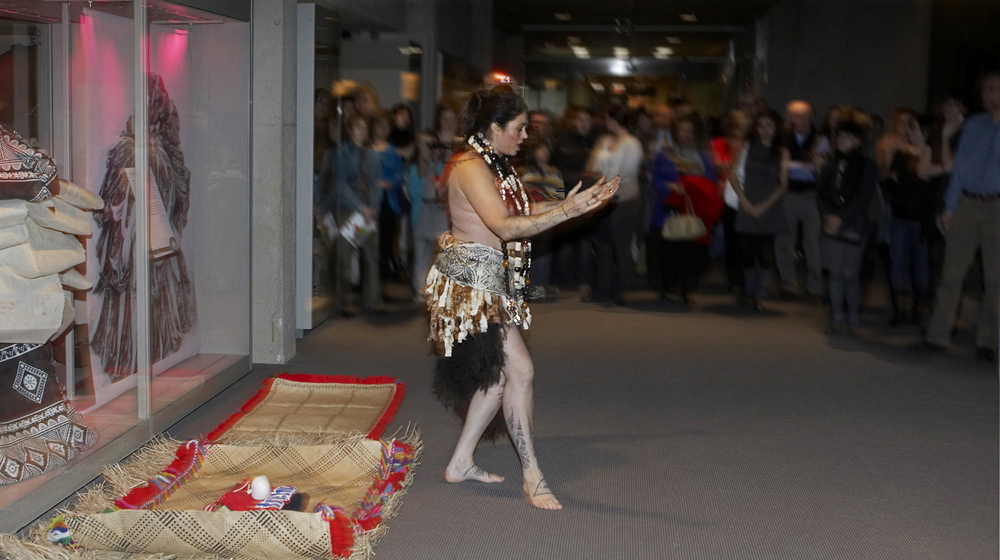
Rosanna Raymond demonstrates this with vigour and grace in her
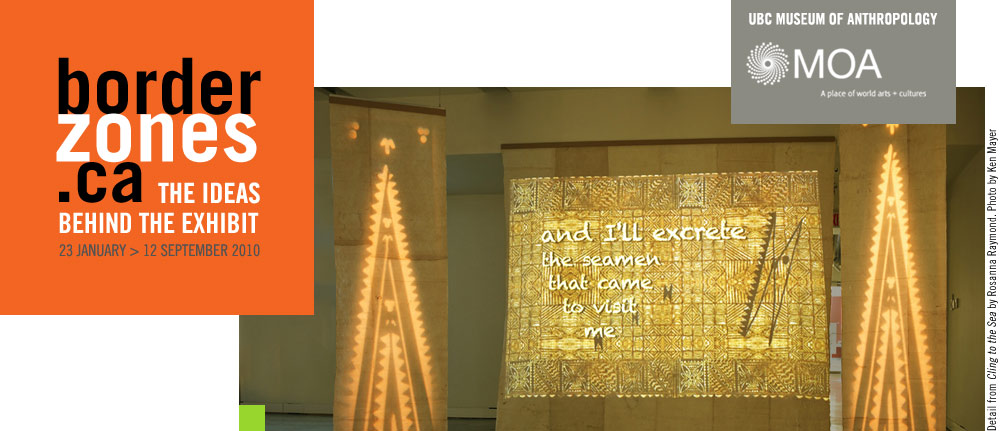
work Cling to the Sea (2010) in the exhibition Border
Zones: New Art across Cultures. The work raises issues crucial
to understanding a tension that often surfaces, under the guise
of cross-cultural expression, between the traditional and contemporary
in art. Rosanna’s work is valuable because it dares to sit
firmly at the crossroads of traditional and contemporary art practice,
trying to resolve this tension without elevating one over the other
or proposing cy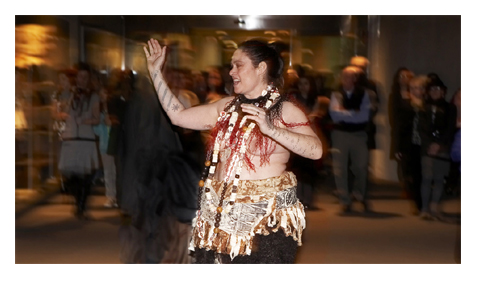 nical
strategies to delay their perceived, inevitable collision. She works
through and honours both; it could be said that she tries to balance
them. Some might see this as a weakness. In my view, the attempt
at balance is what gives her work strength, because it honours the
traditional role of women’s art in Polynesia, which was not
about valorising conflict, but to make art Teu le va—sing
and celebrate relationships. nical
strategies to delay their perceived, inevitable collision. She works
through and honours both; it could be said that she tries to balance
them. Some might see this as a weakness. In my view, the attempt
at balance is what gives her work strength, because it honours the
traditional role of women’s art in Polynesia, which was not
about valorising conflict, but to make art Teu le va—sing
and celebrate relationships.
Cling to the Sea employs, as a starting point, a Samoan
tapa-printing board or upeti collected by Frank Burnett between
1895 and 1927, and part of the Museum’s founding collection.
Rosanna Raymond reignites fai’aiga (a familial bond) with
the upeti by paying homage to the thing itself with a performance
and offerings of fine mats and urban Pasifika streetwear from Auckland,
New Zealand. Like a seed that has lain dormant for over a century,
the upeti needed to be given a wanaga or va‘aga—a new
revolution of va—and be acknowledged with a chant by a storyteller
so that it would once again become a link in the chain of life.
This essay, too, is part of this chain of relations.
Storytelling traditionally involved the voice and gestures performed
in a shared space, and upeti were initially designed to produce
ata (shadows) that were literally cast as patterns onto sacred siapo
(cloths) worn by elevated women like taupou (ceremonial virgins).
Rosanna’s retelling has to deal with a different kind of revolution
of time in the museum: a connected space of global sameness and
difference. The result is what I would like to call a reanimation,
because the upeti has been sung into an image-dominated time and
into a space where time has been literally woven with the images
themselves, making it an (e)motion picture. This is the experience
of the installation, where on one hand images of tapa cloths are
projected as ‘patterns that connect,’ identifying and
weaving relations 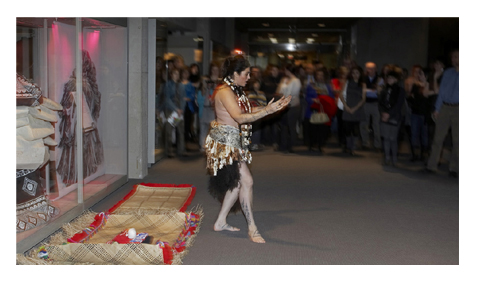 with
which Polynesians are so familiar and comfortable, while the poem
sings a narrative with two or maybe three voices (subject positions
of the poem) connecting ancestors, the ocean, sky, the animate world,
and woman as the beginning and end. with
which Polynesians are so familiar and comfortable, while the poem
sings a narrative with two or maybe three voices (subject positions
of the poem) connecting ancestors, the ocean, sky, the animate world,
and woman as the beginning and end.
Cling to the Sea gives the upeti a new currency that reroutes the
once dormant seed, making it connect with the multiple networks
that crisscross and lacerate the discourse of decolonisation, the
postcolonial, and the cross cultural. This is a new kind of va relationship
that tries to make new relations from tensions between things once
based on village or nuu local polity to what is now a global urban
and cosmopolitan shared space. It sees value in relationships and
shared experiences and musings between dusky maidens, museums, ancestors,
urban savages, and patterns that, like rhizomes, cut across borders,
building links and connecting stories.
Albert Refiti is a Pacific art and architectural theorist based
in Auckland, New Zealand; he is currently a senior lecturer and
head of the Department of Spatial Design at Auckland University
of Technology.
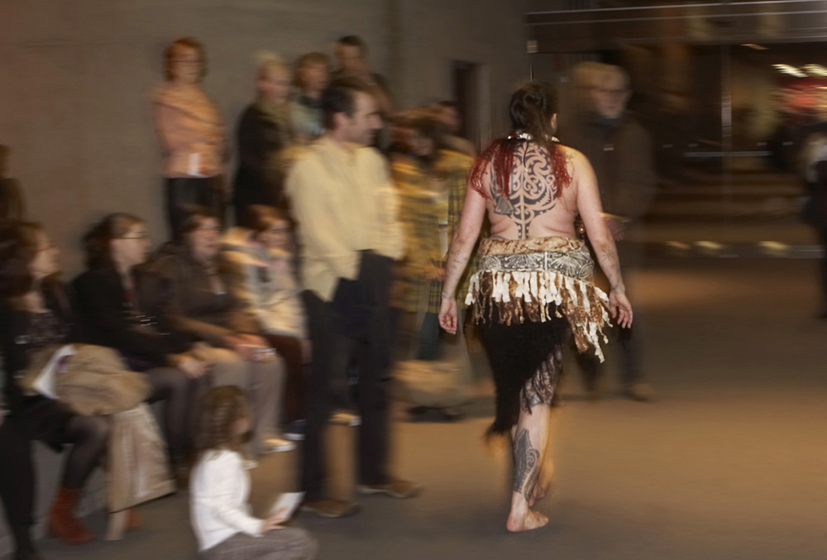
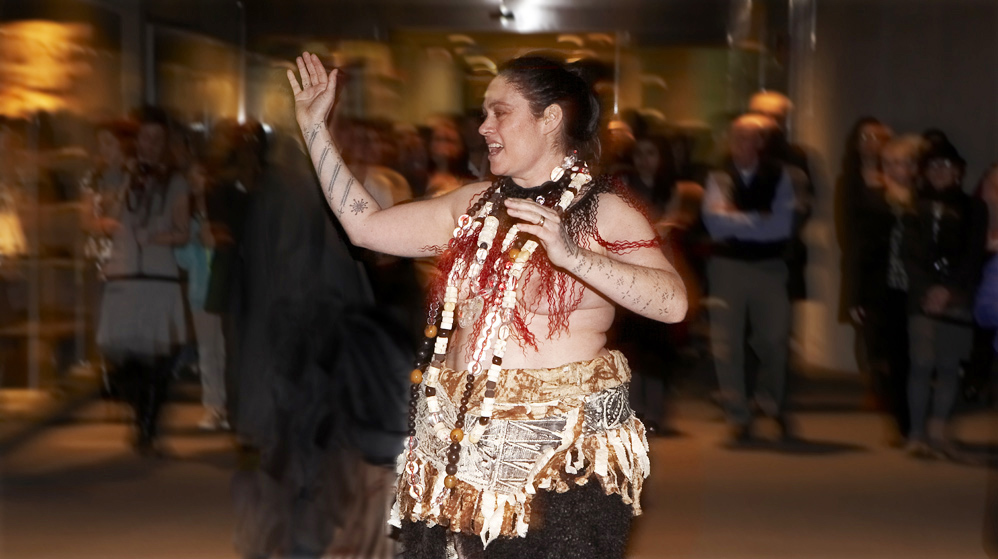
Rosanna Raymond in her performance, SaVAge K’lub,
at the Museum of Anthropology, 26 January 2010.
Photos by Ken Mayer
|
 |