|
        |
|
 |
In her review of Border Zones for this this webzine, Dana Claxton asks: "The burning questions Border Zones: New Art across Cultures raises are about the entire field of anthropological museums meddling in contemporary art. Are former and continuing sites of anthropological engagement even places for contemporary art?" A visitor responds: Yes, museums should certainly "meddle" in art. Art and culture are inseparable. What is contemporary today is historical tomorrow. Even on a practical level, commercial contemporary art galleries cannot engage the same kind of exhibits that museums can afford to host and commission. There is a great need for contemporary art to inform, energise and educate about today's cultural issues. Coming from Europe I am accustomed to great museums with long historical traditions also being extremely active forums for contemporary art. The Victoria and Albert Museum in London springs immediately to mind, for instance. I strongly encourage MOA to follow this direction.
jamie griffiths
|
|
   |
|
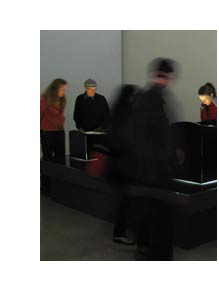
I am interested in knowing more about your thoughts as an artist on the display of your work. I thought that an artist would be dreaming of the moment to display their art in a gallery to share with others. Are there many ceremonial contexts for you to display your art? How do you decide what to show and what to keep hidden? My friend is an artist and as he became more known and his art become more desired he had to be careful with the pressure from the service industry. Some people who loved his art wanted something slightly different, something that wasn't representative of his story, and he was quick to tell them they couldn't decide how his work was going to look. I imagine it is hard for many artists to make a living, and so some may have to develop art to satisfy the consumer instead of to tell their stories. Do you still agree this would be considered art? Have you ever been faced with this situation? Kelly
The decision to make work for oneself and work for the public is always a dilemma faced by artists. I think Pacific Northwest Coast artists in particular are faced with the demands of the public for certain types of works as the purchase is their bread and butter. I feel fortunate in having been able to access public funding (Canada Council, etc.) to create works outside of this pressure, such as the works you experienced at MOA. In regards to your other question, not all art is meant to be viewed by the public. In my case, however, the public engagement of my work is a highly conscious element that is an integral part of the conceptualization. I consider context of exhibition, histories of place, physical spatial engagement, and cultural appropriateness very carefully. Marianne Nicolson
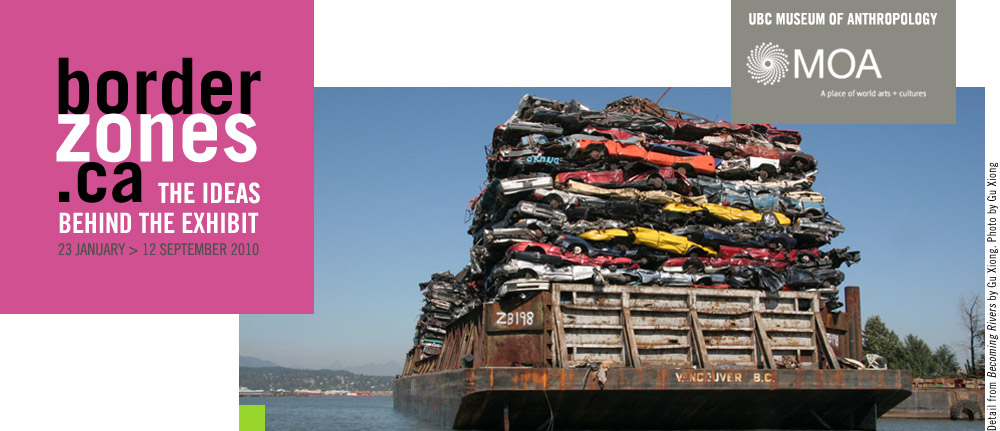
Write to us if you have any questions about the Border Zones: New Art across Cultures exhibition at info@moa.ubc.ca. We would love to hear from you.
|
 |
 |
|
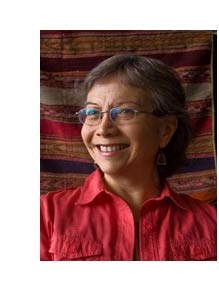
(An earlier version of "Travesías/Journeys" was translated into twelve languages for the exhibition Journey at the Surrey Art Gallery, 2002.)
Listen to Carmen Rodriguez interviewing curator Karen Duffek and artist Gu Xiong on CBC’s Canadá en les Américas. NOTE: The interview begins 4:06 minutes into the show.
Carmen Rodríguez came to Canada from Chile as a political exile following the August Pinochet military coup in 1973. In her writing she explores place, language, and the emotional terrain of dual geographies. Her work is the product of a bilingual, bicultural process: she writes by moving back and forth between Spanish and English until she is satisfied with the end result in both languages.The award-winning author of a short-story collection and a body to remember with and a poetry volume Guerra Prolongada/Protracted War, Rodríguez is currently teaching Latin American Literature in translation and Cultural Studies at Simon Fraser University, and is Vancouver correspondent for the Latin American section of Radio Canada International.
|
|
 |
|
|
|
 |
|
|
|
 |
|
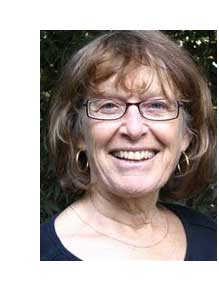
My experience of borders is primarily through my experience of fifteen years as a female carpenter building houses, bridges, and highrises. When I stepped onto my first construction site I didn’t know I was entering a foreign country, a new culture, crossing a border. I’d been taught—as a woman—to be polite and physically needy, to defer to men. Yet here I could be physically strong, competent, and confident, and deferring to a man (unless he was my foreman) was inappropriate when I was making the same good money as the other carpenters, doing the same job. The Canadian Oxford Dictionary defines border as an edge, “especially for strength or decoration” and as a “coming close to being.” Construction was all that for me. It wasn’t easy, but it was a place where I learned strength (in every meaning of that word), where I enjoyed the beauty of physical labour and producing a concrete product that would last a lifetime, and where I could be the most whole as a human being that I have ever been.
Kate Braid is a writer, educator, and carpenter. During her early years in construction, with no other women to talk to, she began talking instead to her journals, keeping copious notes to try to understand the very male culture of construction (”Why are they acting like this? Why am I?”). Eventually, as the working days grew longer and her lines shorter, she realized she was writing poetry.Her most recent book of poetry about her experiences in construction is Turning Left to the Ladies (2009). Kate is currently working on a prose memoir of her fifteen years in construction.
|
|
 |
|
|
|
 |
|
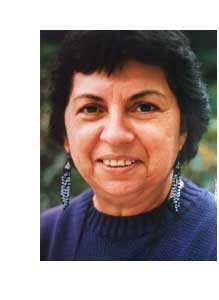
To live in the Borderlands means you are neither hispana india negra española To live in the Borderlands means knowing Cuando vives en la frontera To live in the Borderlands means to Living in the Borderlands mean you fight hard to In the Borderlands To live in the Borderlands means To survive the Borderlands
__________________________
Born in the Río Grande Valley of south Texas, independent scholar and creative writer Gloria Anzaldúa (1942 – 2004) was an internationally acclaimed cultural theorist, poet, and children’s author. Her work, which has been included in more than 100 anthologies, has helped to transform a variety of academic fields. Her writing plays with the power dynamics of language—one of the many borders she addresses in her work—by weaving English and Spanish together as one language.One of her major contributions was her introduction of the term mestizaje—meaning a state of being beyond binary (either/or) thinking—into academic writing and discussion. In her writing, Anzaldúa calls for a "new mestiza," an individual aware of her conflicting and meshing identities and who challenges binary thinking in the Western world.
|
|
 |
|
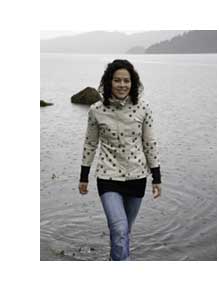
I drew him a map of the section of forest we needed to run transects through. He had never seen a map before, and didn’t understand it. Yet in his mind, Biri biri knew every section of the forest. We had walked most of it for my Pingkayapo tree survey save one last section. I kept asking him about it, and he kept saying (in Portuguese), "But there are no Pingkayapo there.” “Have you walked it?” “No. There are none of our trees there.” For the sake of science, we had to walk it to have ‘proof’. When he realized I was determined, the Kayapo guide took off with me chasing him into the nastiest bush we’d bushwacked in the six weeks I’d been in the Amazon. It was scrubby, viney, stinging business, and I struggled hard to keep within earshot of him. It took hours. When we returned to our little research station we had not found a single Pingkayapo. It was another example of my effort to straddle the worlds of scientific methods and traditional ecological knowledge, one costly in sweat and time, and that only reinforced what we both already knew: in the forest, the Kayapo are right.
Severn Cullis-Suzuki has been active in environmental and social justice work since kindergarten. At age 9, after witnessing burning in the Brazilian Amazon on a trip with her family, she started the Environmental Children’s Organization with her grade 5 friends. Severn has a Bachelor of Science degree from Yale University, and recently a Master’s degree in Ethnobotany from the University of Victoria.
|
|
 |
|
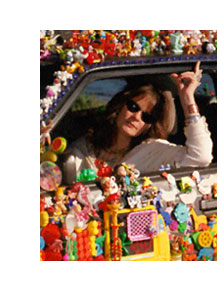
My parents were cross-border smugglers. Every summer we sailed to the San Juan Islands where my father stocked up on his annual supply of Camels, which he hid in a rope locker under his bunk. My mother always invited the Customs and Immigration Officer in Sidney, where we re-entered Canada, for a cup of tea, seating him atop the contraband. I learned to view the border as a kind of Honour system that discourages complete disclosure. (I've smuggled everything from Colombian emeralds in my bra to panties from Victoria's Secret in Bellingham.) I drive to Blaine, discard my kids' old clothes in Duty-Free shop washrooms and drive home back over the border to the True North strong and free, the kids dressed in multiple layers of back to school duty-free clothes. It's so much easier to neglect mentioning the contraband than spending the day having your car taken apart wing nut by bolt because you declare the medicinal marijuana you carry with you for depression — which always hits after you take the kids shopping. Perhaps our national motto should be amended to read, ”From sea to shining sea: Nothing to Declare.”
Susan Musgrave is a Canadian poet, children's writer
and educator. She
has published over 20 books and has been shortlisted for the Governor
General’s Literary Award for Poetry. Her most recent book is Obituary
of Light: the Sangan River Meditations (2009).
|
|
 |
|
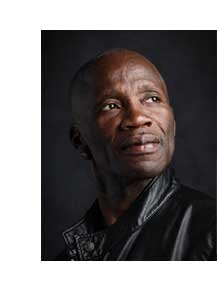
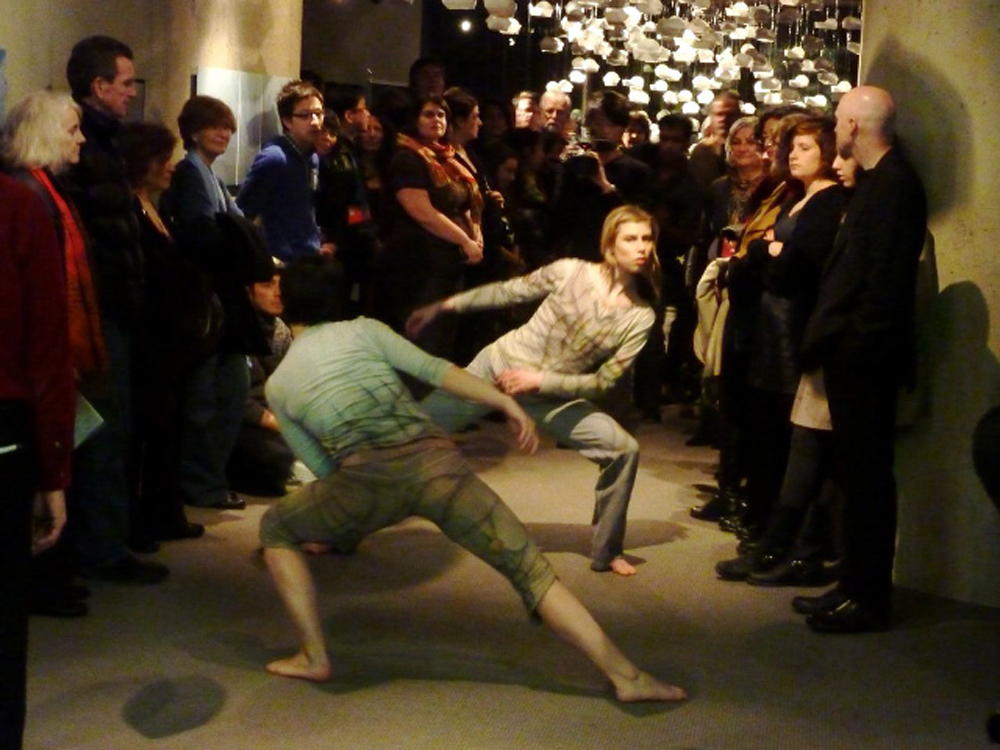
Dance is an expressive activity that we engage in for a multitude of reasons, from a desire to simply celebrate to a need to engage in an act of catharsis. Whatever the reasons, there is always an underlying need that requires an overt physical resolution. My own lifelong engagement with this art form has taken me to countries where I spent considerable time with people whose customs and languages were sometimes quite different from my own. In one sense these differences could be seen as barriers, but I have always taken them on as challenges, firstly to better understand myself, and secondly to understand others and their world. This then, underlines the nature of the ‘dance’ that I am engaged in. It is one that seeks to discover, explore, articulate, present, and re-present what we know and what we think we need to know. Sometimes these discoveries are not what we hoped for or intended to find; indeed they can sometimes be quite painful. Because I have lived in communities that I was not ‘native’ to for most of my life, the need to understand and adapt to my environment has always been a pressing issue. This can sometimes be quite overwhelming, to the point where additional and/or artificial borders, walls, or barriers can be erected in an effort to ‘protect’ oneself. Still, I see and hope that an art form such as dance can create a space and a place for an honest dialogue. This is where my practice as an artist begins.
Henry Daniel has an MA in Dance Studies from City University, The Laban Centre, London, specializing in Sociology of Dance, Choreography and Choreology; and a PhD in Dance, Performance Studies, and New Technology from the University of Bristol in the UK. He has also acted with Derek Walcott's Trinidad Theatre Workshop and danced with the Trinidad Repertory Dance Theatre.
|
|
 |
|
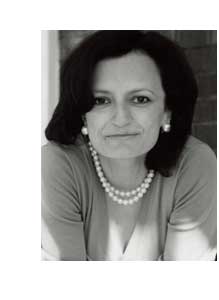
Borders are boundaries. Aren’t they wonderful? They keep us polite. Aren’t they terrible? They deaden our souls, they dull us down, they send us to bed early, turn the world slug-coloured and make us too weary to open a book or visit a gallery to see one gorgeous picture. See? That inadvertent word spillage shows how much I resent borders, which are the thick black rules inside my head that tell me not to write freely. The world is full of editors to keep writers inside borders—perhaps that is as it should be—but there’s a long, dark border in your own personal brain pan and unless you breach it, you’re going to bore for Canada. And so many writers do. I imagine the world as sprayed with words, many of them bloody rude and
deeply upsetting, but they land on the earth and build up like steaming
mulchy compost and I just want to roll around in it and enjoy it. I want
the UBC Museum of Anthropology exhibit to encourage artists to stretch
and break and bust those rigid borders. I’d say more but you only granted me 200 words and I have reached my border now.
Heather Mallick is a Canadian author and journalist.
|
|
 |
 |
 |
 |
 |
 |
 |