|
 |
|
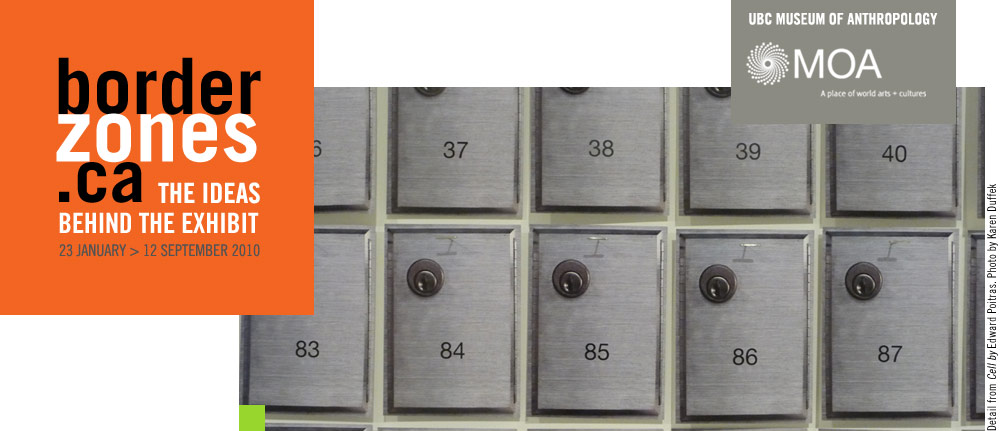
Lo-fi. Simple materials, improvised, a single
colour copy of a post-office box repeated over and over, numbered
from 1 to 1392, to represent a post office.
Hi-fi. Faithful memory, the endless search for
truth, solid ground. The Greek word for solid is “stereo.”
Wi-fi. The wireless imagination, telepathy, connecting
ideas across space and time.
I spent some time with Edward Poitras in Regina. We made an informal
video together called Wascana. He took me to a place outside the
city where the prairie dips down. There is a creek bend and some
trees, sheltered from the wind, a good place for a camp. No people
there now. He explained for me the word wascana, from oskana,
bones, which describes the place now called Regina, “place
of bones”—and that these were not just buffalo bones
but must also include many human bones. Wascana Park.
We bumped into each other again in Paris, at the opening of the
new Canadian Cultural Centre. The Prime Minister attended. It was
an exhibition of so-called First Nations art. Edward had contributed
a sophisticated “virtual reality” piece exploring the
cosmos. There were other multi-media installations, too. Over lunch,
Ed quipped that the message the Canadian government wanted to send
to France was, “Hey, we’re so hi-tech in Canada, even
the savages can do this stuff!”
|
 |
|
 |
|
Like the mystery of information passing through any post office
at any given time, Cell is a non-narrative web of images
and allusions that we navigate by chance and free association, adding
our own links and stories as we go. What follows are a few postcards.
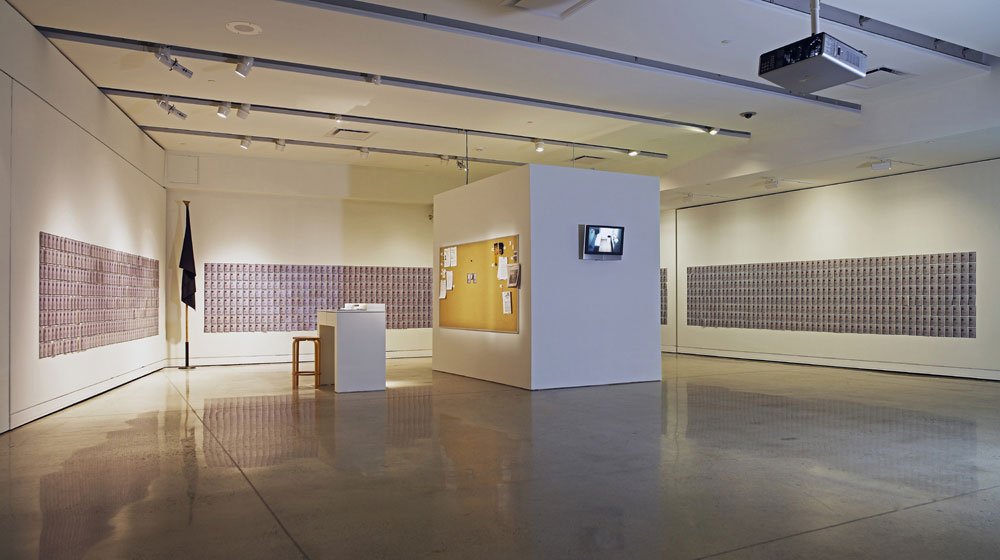
Rows of colour copies pinned to the wall form a bank of post-office
boxes, along with other expected institutional items: a community
notice board, a flag, a counter with forms to fill out. The corkboard
bears the beginnings of new narratives, scrawled on bits of foolscap,
personal messages illustrated with the occasional photograph, promises
by the author/researcher/artist of more to come. Over fuzzy ID shots
of familiar historic characters—Jim Brady¹, Leonard
Peltier²—light is shed. We might just as well be at
a border crossing, or in a police station, or in a school.
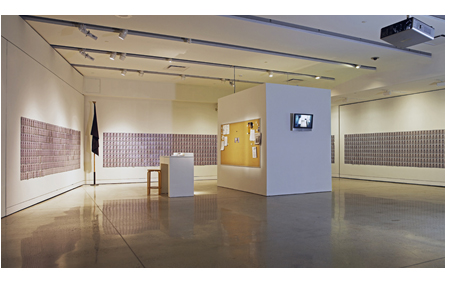
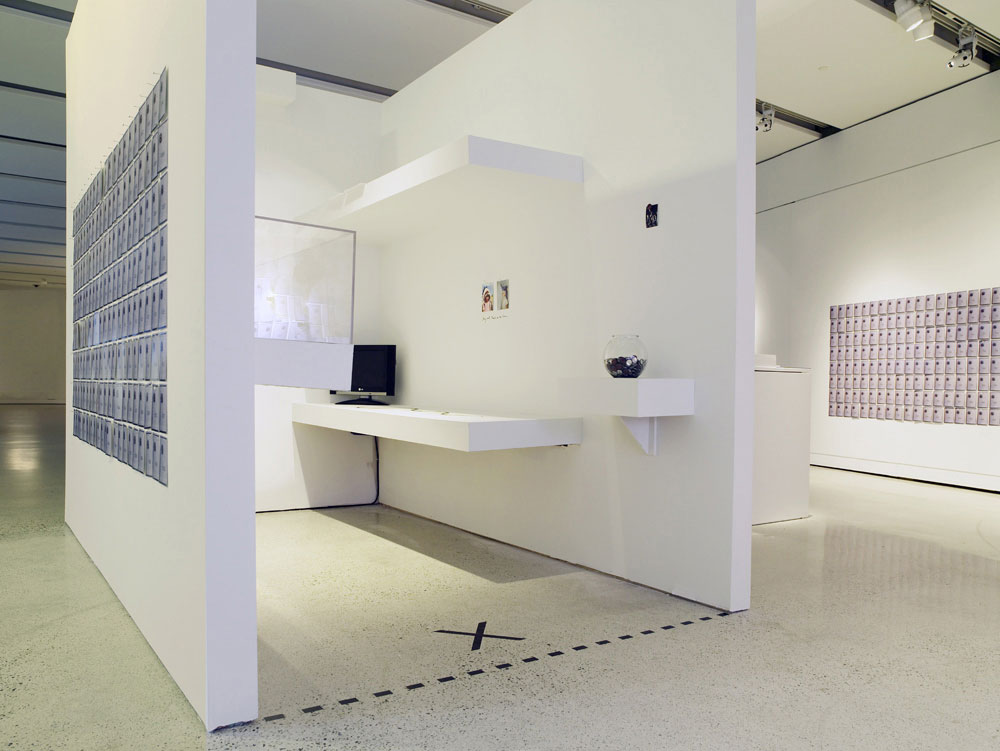
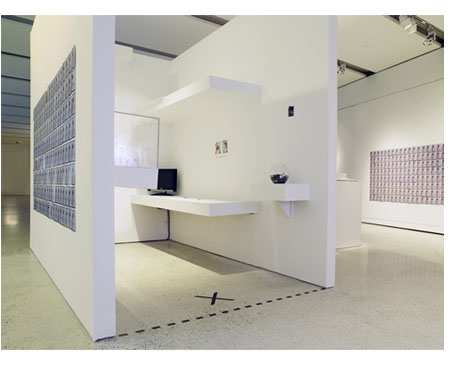
Tucked in behind, where a dead-letter bin might be expected, is
an enclosed space the approximate dimensions of a jail cell, containing
a series of cryptic artifacts. We contemplate these objects, isolated
in their glass box, wondering how they might connect to the story,
inserting them into our own cognitive models of the universe. Each
object, each image has its own trajectory, and leads us off along
another storyline. Later, outside again, we see that we too were
being watched, by a surveillance camera—that we too are artifacts
on display. The museum is like that, a place for looking. Others
can look at you looking. Here there are multiple points of view
and many unspoken communications. As Marcel Duchamp said, you can
see someone seeing but you cannot hear someone hearing ("On
peut regarder voir; on ne peut pas entendre entendre”).³
By now it should be clear that the claims of the state to the land
are illegitimate, founded in superstition and greed. But if we are
to start again, as we must, where would we begin? With God? We’ve
tried that. Theology was used by the Europeans, after all, as an
instrument of imperialism, justifying expropriation and genocide
on a global scale. And clearly, fundamentalism is not working. Or
we could pluralize, listen to the gods, who are one and many, who
are the voices of the land born also of our own inner nature that
includes the land, the animals, and the stars. This would be to
understand that we are not owners but here only to care for and
respect the land. The Dalai Lama says, simply, “We.”
This suggests that there is no more Other. Those days are done.
The new vision of Humanity, free of colonizing universalisms, states
that we are all in this together. The endless construction of enemies
is coming to an end. And it’s not just people here. “We”
includes rocks and bones too.
|
|
|
 |
|
Today we are networks of cells and cells in the network. The
network has no edges, no end. We are immersed in an unfinished,
ever-unfolding story with infinite subplots. And each of us has
a front-row seat. Like back in the days of “mail art,”
anyone can choose, for a moment, to be the centre, each star reflecting
every other.
The post office opens and closes. Each time you go in you get an
audience with the state. For Leonard Peltier, like anyone in prison,
it is the filter through which communication must pass. But isn’t
this also true for us on the outside? Inside outside. Crossing the
border is a strange moment of transformation from one state to another,
as if we too are changed in the crossing.
Here we are, crossing between Guantanamo Nation and Hacker Nation.
Listening to the listeners. During the Vancouver 2010 Olympics,
there were people on the street with clipboards, observing the police
who were watching the protesters, all performing for the cameras.
Sponsored by Pivot Legal Society and the BC Civil Liberties Association,
they wore orange T-shirts that said “Legal Observer.”
Look both ways. In the theatre of democracy, never quite achieved,
we each play a role in an endless play of power, from above and
from below, at once both transcendent and immanent.
There is a Black community on Saltspring Island, descended from
immigrants who came from California in the 1850s seeking a utopian
alternative. They arrived at the invitation of Sir James Douglas,
the first Governor of British Columbia, whose mother was a Creole,
a free coloured, from Demerara (British Guiana). They were
granted land and the right to vote. Douglas’s wife was Cree.
Like so many before, they were looking for a quiet place where they
could live in peace. When we talked about Cell, Edward
told me about the place where Leonard Peltier went, up in northern
Alberta, before he was apprehended by the “horsemen.”
It was a similar attempt to move north, to find a refuge, just as
Sitting Bull had done not so long before. Much remains unresolved.
We each play a role in the rhyme of post-office, from Rome to Samoa.
Last year I saw Sitting Bull’s headdress on display at the
Royal Ontario Museum. It was as if he was there, looking back at
me. The whole idea of First Nations suggests that they were here
before, but in fact here they are right here right now, a living
part of the contemporary world. Here we all are. And if what we
are talking about is the land and how to save it from global annihilation
then surely we should be listening and following the way of these
people of the land. First Nations, Last Nations, we are so many
nations, each of us a nation of cells as countless as stars, no
longer separated from other nations by borders or periods of history,
but stories crossing and passing over each other like so many letters
in the post, sharing all of time in a translucent palimpsest.
1. Jim Brady (born 1908, disappeared 1967) was a Canadian Métis
political leader. He is regarded as one of the most influential
Métis leaders of his era. Brady helped to found numerous
political organizations, including the Métis Association
of Alberta, the Métis Association of Saskatchewan, and the
Métis Association of La Ronge. Jim Brady disappeared in northern
Saskatchewan while on a prospecting trip with a Cree friend in June
1967. Their remains were never found, fueling speculation that they
may have been murdered, or assassinated for his political activities
(http://en.wikipedia.org/wiki/James_P._Brady#cite_note-2).
2. Leonard Peltier (born 1944) is a citizen of the Anishinabe
and Dakota/Lakota Nations. He is a member of the American Indian
Movement (AIM), and was convicted and sentenced in 1977 to two consecutive
terms of life imprisonment for the murder of two Federal Bureau
of Investigation agents during a 1975 shootout on the Pine Ridge
Indian Reservation. The uncertainties around this case suggest strongly
that Peltier did not receive a fair trial. Numerous lawsuits have
been filed on his behalf but none have succeeded. He is one of America’s
best known political prisoners.
3. Michel Sanouillet, Marchand du Sel, Le Terrain Vague, Paris,
1958 (writings of Marcel Duchamp, collected and presented in collaboration
with the author)
Hank Bull is an artist whose interests include radio, performance
and networks of exchange. He is currently executive director of
the Vancouver International Centre for Contemporary Asian Art (Centre
A).
Detail photos from Cell by Edward Poitras. Photos by Ken
Mayer
|
|
|