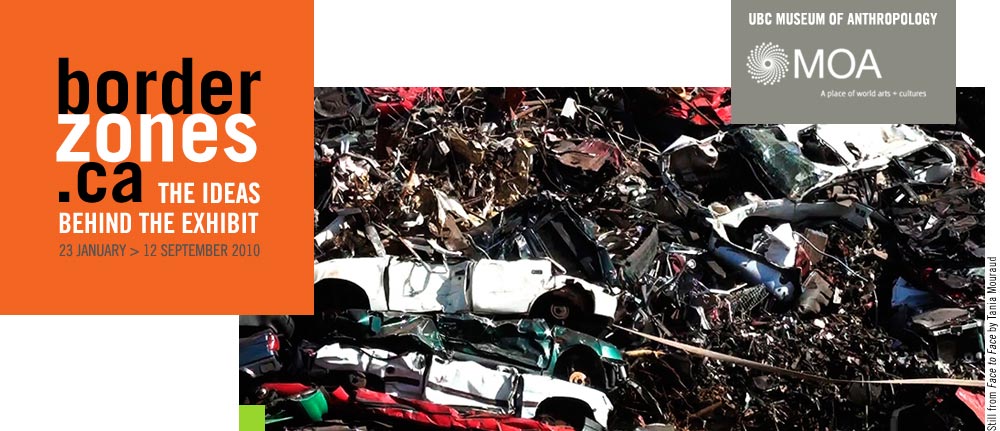
Face à Face
Par Pierre Petit
L’air est glacial, la mer est proche. Les wagons avancent lentement
à la recherche du quai correspondant à leur chargement.
Le tri sélectif à été réalisé,
le convoi s’arrête, les grues s’activent. La répartition
est programmée : la fonte d’acier dans les premiers wagons,
les carcasses colorées de notre quotidien , frigidaire, voitures
et autres dans les derniers. Les griffes d’acier plongent dans les
tas de ferraille, les bulldozers poussent et remontent tout ce qui échappe
à cet enlèvement. Le ballet mécanique est rythmé
par le dialogue sonore entre les engins et les tas qui en sont les instruments..
Cette intallation de Tania Mouraud au MOA prend en compte l’histoire
d’hier et d’aujourd’hui pour en faire le présent.
C’est notre lien avec le passé qui rend actif notre devenir
dans ce troisième millénaire. L’installation Face
to Face nous renvoie à notre engagement dans ce monde. Production,
résidu, recyclage forment un cycle qui se régénère
constamment dans notre société industrielle comme le montre
ces wagons qui s’immobilisent le temps d’un chargement et
repartent. Le mouvement incessant d’aller et retour des trains,
le ballet des grues qui plongent leurs pinces dans les tas de ferraille
et les déconstruisent constitue une chorégraphie qui se
déplace au rythme d’une composition sonore où les
sons d’origines sont là pour nous en rappeler les enjeux
.
Ce processus occupe et envahit l’espace comme une symphonie contemporaine
à laquelle on ne peut échapper : dans Face to Face, pas
de diversion. Le son nous renvoie à notre quotidien et nous interroge
sur notre futur. Les personnes sont apparemment absentes dans le dispositif
; en réalité cette absence n’est qu’un leurre.
Elle permet au visiteur d’être acteur dans l’installation
Face to Face.
Face to Face
by Pierre Petit
The air is icy; the sea is nearby. A train moves slowly as if looking
for the right place to take on its freight. The train finds its platform
and pulls up. The loading cranes get to work. Everything has been programmed—cast
iron in the first few cars, the multi-coloured forms of fridges, vehicles
and other commodities of everyday usage go into the rear cars. Great steel
claws plunge into the heaps of metal, while bulldozers gather up and carry
away anything that escapes the steel grasp. This mechanical ballet is
danced to the rythm of a soundtrack in the form of a dialogue between
the two performers—the machinery and the freight.
Created by Tania Mourand for MOA, this installation takes a look at yesterday's
and today's history out of which the present is molded. It is our connection
to the past that gives vigour to our advance into the third millennium.
This installation, entitled Face to Face, forces us to examine our commitment
to the world: production, residue and
recycling are part of a cycle that is constantly replayed in our industrial
society. Thus, the train stops for as long as it takes to load the freight
and then it rolls on. The incessant movement of the trains backward and
forward, the dance of the cranes plunging their
claws into piles of metal and ripping them apart: all this movement is
choreographed to the rythms of a soundtrack whose composition reminds
us of what is at stake.
The space of this installation is occupied, even invaded, by a process
akin to a contemporary symphony from which there is no escape. Face to
Face requires us to look at our daily lives and poses questions about
our future. It would seem that people as such are entirely absent from
this installation but, in fact, their absence is rather a bait that lures
the visitor into becoming an active participant in Face to Face.
Pierre Petit
Artist
Professor, aux Beaux-Arts de Tourcoing (North)
(English translation by Tatiana Charters)
|