|
It started, as post-colonial museum challenges often do, with
an artist, who is also a Canadian university professor and a Hindu.
He sees bronze sculptures from India in the museum collections as
“trapped” in their cases, following a tendency of some
people to see museums as high-end prisons. Prisons were, after all,
also once visited as spectacles by the privileged and well educated,
just like museums.
Hindus regard these sculptures as receptacles or vessels of divine
power and objects that sometimes take on the presence of the deities
they represent. There is consequently, for some, an uncomfortable
distance between the sculpture, undressed, isolated, and subject
to a dispassionate aesthetic gaze, as in a museum, and the sculpture,
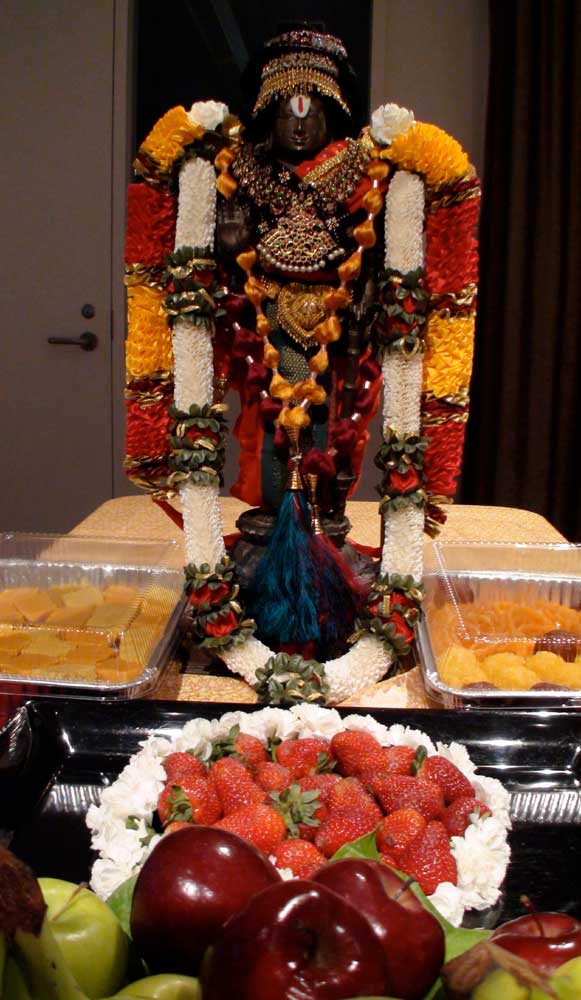
dressed, bejewelled and garlanded, subject to a worshipful and reciprocal
gaze, as in a temple.
Niranjan Rajah, the artist, and Karen Duffek, the Border Zones
curator, invited a Hindu priest to the Museum of Anthropology (MOA)
to discuss whether a sculpture could be reactivated or re-sanctified
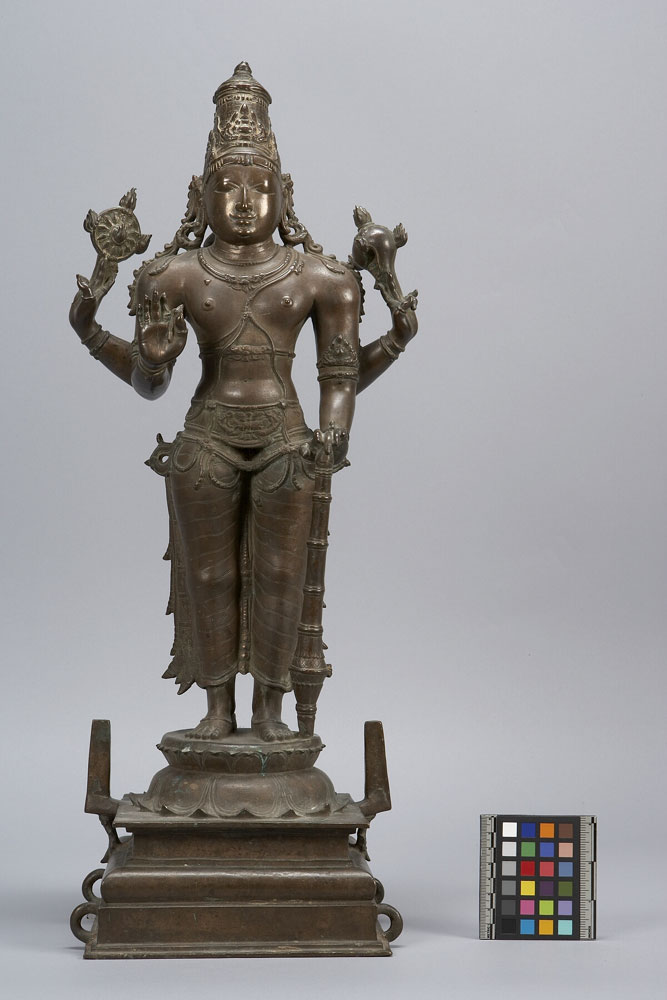
for worship. The chosen sculpture was a bronze image of the Hindu
god Vishnu. Prabakar 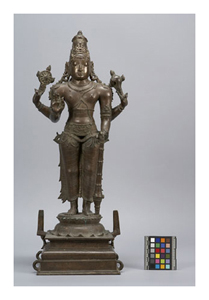 Visvanath, a priest who leads a Hindu temple in the suburbs of Vancouver,
confirmed that this was possible with the appropriate ritual, one
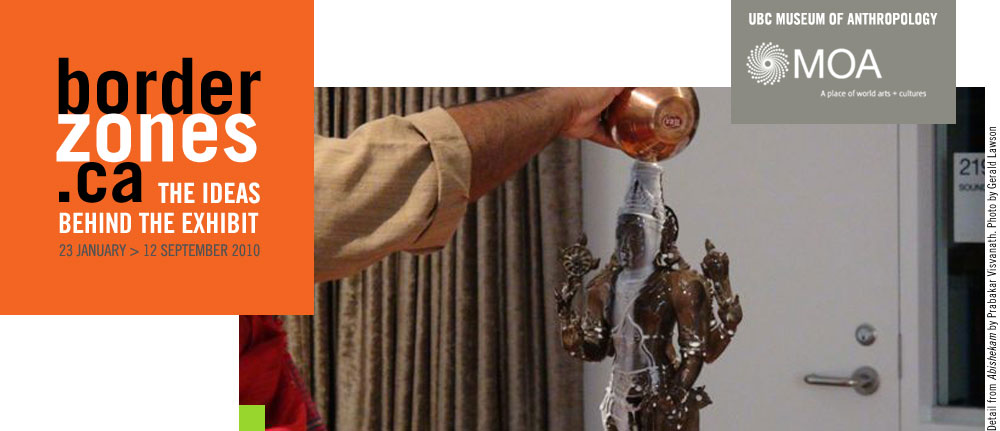
called an “abishekam.” The curators wanted to film this
process, footage that would be shown as a kind of installation work
in the Border Zones exhibition.
Visvanath, a priest who leads a Hindu temple in the suburbs of Vancouver,
confirmed that this was possible with the appropriate ritual, one
called an “abishekam.” The curators wanted to film this
process, footage that would be shown as a kind of installation work
in the Border Zones exhibition.
It is important to acknowledge a few of the challenges posed by
such a project. The first is in conservation. “Posterity”
has always been a justification for the long-term costs of maintaining
the vast collections of museums. The preservation of objects that
would deteriorate and disappear in everyday use is a very special
responsibility. The benefits of this mission consider future generations
and long-term rather than short-term goals, in which a museum’s
mandate is to preserve material culture.
This project involves suspending some central rules of conservation.
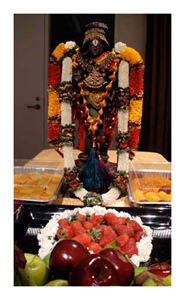 These include some fairly heavy touching of the artifact, because
it has to be dressed, bejewelled and garlanded with flowers as part
of its revival and worship. The worship includes burning incense
or camphor and offering food, flowers, and fruit to the God, all
of which poses challenges to museum regulations. It may also include
exposing the artifact to climate conditions outside the temperature
controlled museum environment. This is after all, a processional
image, fitted with lugs and rings so that it can be periodically
taken out in a festive procession.
These include some fairly heavy touching of the artifact, because
it has to be dressed, bejewelled and garlanded with flowers as part
of its revival and worship. The worship includes burning incense
or camphor and offering food, flowers, and fruit to the God, all
of which poses challenges to museum regulations. It may also include
exposing the artifact to climate conditions outside the temperature
controlled museum environment. This is after all, a processional
image, fitted with lugs and rings so that it can be periodically
taken out in a festive procession.
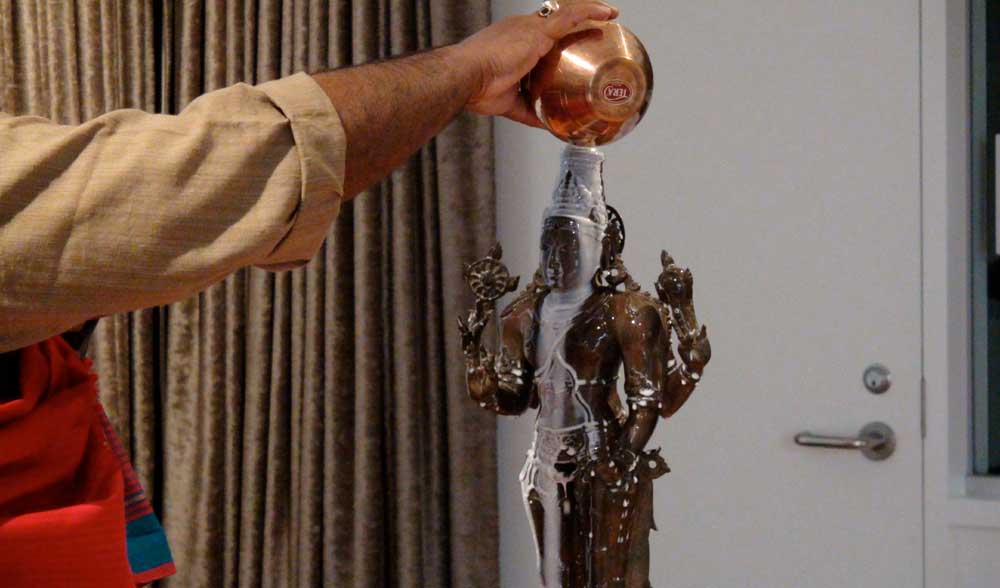
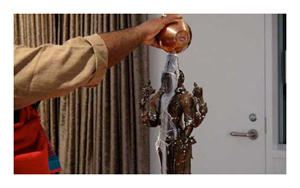
Most challenging of all is the necessity, during the revitalization
ritual, of bathing the icon in a succession of liquids. Imagine
telling conservators you work with that you were planning to pour
over the head of your artifact water, then milk, then oil, then
honey, then yogurt, then fruit salad. No wait, maybe it’s
best not to mention the fruit salad at all.
The classic push-pull between conservators and the curator is one
of the creative tensions of museum work. The introduction of ritual
almost always exaggerates this tension, often unhinging it from
the usual zone of contention, not to mention traditional mandate
and legal responsibilities.
The second challenge has to do with sanctity. Because religion
is one of the drivers of distinctive material culture, ethnological
museums are full of objects that were once sacred to someone, objects
that once embodied, contained, or were charged with sacred power.
 Part
of the viability of museum representation has been the capacity
to distance sacred objects from their active contexts, through time
and space, and to treat them as symbols or illustrations of power,
rather than objects of power themselves. Part
of the viability of museum representation has been the capacity
to distance sacred objects from their active contexts, through time
and space, and to treat them as symbols or illustrations of power,
rather than objects of power themselves.
The prospect of re-sanctifying all or even a good number of objects
in a museum collection is daunting, and for some, even opening that
door is impractical. In the case of the Hindu sculpture, some would
say that the revitalization would oblige the museum to maintain
a regular program of worship. A museum is not a temple, nor are
curators priests, despite the origins of the terms. But is the museum,
as it moves into closer cooperation with the communities whose cultural
traditions it represents, really so immune to the sacred?
At the Canadian Museum of Civilization where I work, we have for
years arranged religious specialists from First Nations to periodically
bless and “feed” particular objects in storage that
they feel need such attention. We also have a fully consecrated
orthodox Catholic church in our History Hall, where weddings or
other ceremonies have been performed. At MOA, masks from the collection
have been loaned to First Nations so that they can be used in dance
ceremonies hundreds of miles away. And MOA also successfully built
a small mosque in the museum at which prayers were conducted during
a temporary exhibition. It is important to acknowledge that these
are examples of how far it is possible to extend collaboration with
communities, rather than some new program that would replace all
the traditional functions of the institution.
New curatorial approaches view artifacts not as static relics to
be collected, catalogued and preserved, but also as repositories
of meanings within dynamic cultures whose stories and values change
over time. The receptacles, the paraphernalia, the practitioners,
and the devout are all at the door. What happens when Vishnu comes
to call?
Stephen Inglis is an anthropologist who has specialized in artists
and their communities in South Asia, and has also worked extensively
on folk art and craft traditions in Canada. For more than twenty
years he directed research at the Canadian Museum of Civilization
as Chief of Folklore, Director of Research, and Director-General
of Research and Collections. He is now an Adjunct Professor of Art
History at Carleton University.
Photo #1, MOA Collections Photograph
Photo #2 and #3 by Gerald Lawson, 14 October 2009.
|
 |