|
 |
|
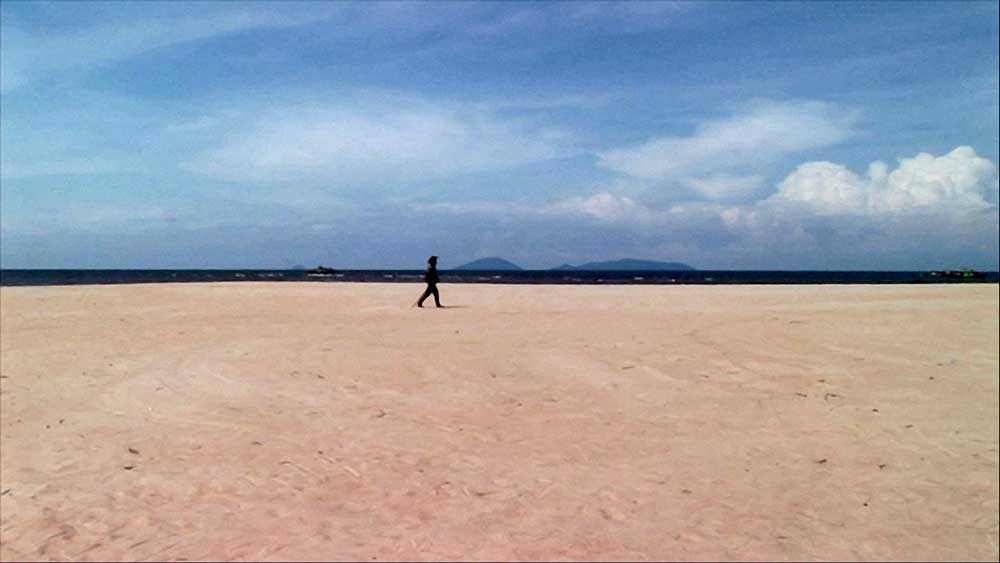
It is strange staring at the horizon in Hayati Mokhtar and Dain
Iskandar Said’s Near Intervisible Lines. Almost perfect halves—sky
above, land below. Except it is also ocean and beneath the sand
are traces of lives once lived here. Unseen.
It is also strange because this work mirrors imagery I created
in the film Kainayssini Imanistaisiwa: The People Go On.
Except it was the land in Kainai territory in southern Alberta.
I also wanted images of the horizon equally divided—I was
trying to find a way to represent the four directions of the land
in two-dimensional screen space. In post production, I letterboxed
the images and then linked them in a continuous ribbon of horizon.
It was a simple statement: space behind you, in front of you, all
around you. That is where the Kainai stand and see, thousands of
times a day.
In Near Intervisible Lines, the horizon appears like a
line on a flat space—criss-crossed randomly by movement across
the flat plane, suggesting an almost abstract formalism. Then there
are the stories, histories, and songs creating trajectories of memory
and distance, of perspective in time and place: tension against
the formal elements.
“The site lent itself to our exploration of the shifting
and often oppositional tensions that function at the foundations
of the concept of landscape,” says Hayati; “The panorama
has the stillness of a painting, and yet social life is all about
process—it is never static—and this fact is emphasized
here by means of the far left screen which traverses the landscape
to uncover further complexities.”
The visual tension draws us to the voices. We hear from the stories
that the land shifts and shakes as the ocean swells, envelops and
rises, recedes and in its receding, erodes. Where there was once
a home is now a postcard beach in Malaysia where tourists would
love to stroll, on the bones of another time. Then it is not a line
at all or a flat surface, or even a horizon, but a place thousands
of miles away that signifies the 360 degrees of space: behind, above,
all around.
|
 |
|
 |
|
As a filmmaker, I choose where to place the camera so the subject
is above the horizon or below the horizon or a vertical line against
the horizon or no apparent horizon. Where I place the camera will
become part of the storytelling and the formal organization of time
and place, light, and shadow.
There is a long history of the horizon, how it plays in art history
and the imagining of Western culture. There is an obsession with
the horizon—striving, reaching, going beyond or even flattening,
rejecting. And there are age-old dichotomies in which the horizon
is always ineffable, unreachable: one is the searching for the idealized
space of beyond. But to the men and women in Near Intervisible
Lines who share their music and stories, the horizon is not
ineffable. It is read from the land, it is read while navigating
the ocean, it is read because, well, that is life. A few thousand
ocean-miles away, the Polynesian canoe culture was reborn with the
help of Mau Piailug, one of a handful of traditional navigators
from Satawal, Micronesia. Piailug taught Nainoa Thompson non-instrument
navigation, wayfaring as some call it. It isn’t just star
navigation without a sextant. It is currents and sky, ocean and
stars—in fact, seeing beyond the horizon.
Malaysia certainly has histories that stretch back long before this
current round of imperialism, where ocean-going vessels from China
and other nations meant reading the ocean for signs of visitors—and
invaders. And from Malaysians, there are histories of trade or war
or migration to other places, where knowledge and lineage were exchanged
and oceans navigated.
In Near Intervisible Lines, the histories and stories
imagine a different geometry of time and place, told in a steady
current of moving camera and framing off and then on again, editing
from one story to the next, with soundscape and music. And there
is a lament for the loss, for the long ago, for the homes that stood
there and are now gone, for the work that was performed and the
expectations for a constant place.
There has never been a constant of any part of any society or culture.
There are always trade and migration, assimilation and resistance,
border zones and transgressions, war and diplomacy. Here on the
west coast, where it takes 19 hours to drive to Kitamaat, it took
days by ocean-going canoes and catamarans, yet families, clans and
villages were renewed with marriages and trade. Currents were navigated
to visit neighboring villages where celebration, gossip and knowledge
were exchanged. Here, visitors came from China and Japan years before
Europeans, and over the mountains from the prairies and from the
south along ancient routes other visitors arrived on their own journeys.
|
|
|
 |
|
“From the ‘Incense Route’ across the Middle
East,” says Dain, “to the ‘Silk Roads’ of
Central Asia or the maritime ‘Spice Routes’ that brought
the ancient Egyptians into contact with the peoples of the Moluccas
in the Indonesian Archipelago… [this] was the matrix of the
Asian civilization. Our current ‘discovery’ and much-touted
tropes on globalization would have our ancestors laughing round
their camp fires. Movement was nothing new. Borders were porous,
cultures were on the move and subjected to constant influences.”
But then there was “the arrival of the first European, and
the need to monopolize these age old established trading routes,
that cracked our world asunder.”
That monopoly has played out in more than the trading routes. Museums
are efforts at a cultural monopoly. Even the claim at ‘globalization’
could be argued as another effort to monopolize the trade routes.
Art practice is valued or not valued, voice is heard or not heard,
space is opened or not. Artists must negotiate many oceans and different
horizons while offering up what will play in art houses driven by
monopolistic cultural purveyors.
Dain and Hayati signify but do not mimic Western art traditions.
Perhaps that is what I value most about Near Intervisible Lines.
Their art practice is porous like the borders of old—they
situate themselves within and without landscape and concepts of
the horizon once the line is drawn. “We embarked on the project
by wanting to look at the relationship that people have with place,
and our ‘place’ in that relationship,” they explain;
“how we would translate and transform ‘their’
world as two people who share their culture… but not quite.”
And from that, they hybridize but do not assimilate, they document
not as native informants but as participants in the memory and intellectual,
cultural, and creative knowledge of people.
“Girl. Cree. Metis. White. Writes (been to Sundance Writer's
Lab). Directs (lots of films, many festivals). Thinks (essays that
are full of tersely cogent remarks or flamboyantly theoretical analysis).
Challenges herself and others (why do it like everyone else?). Makes
things happen (without too much fuss and with way too much Cree
humility). And yes, she has many awards and accolades.” -
Loretta Todd
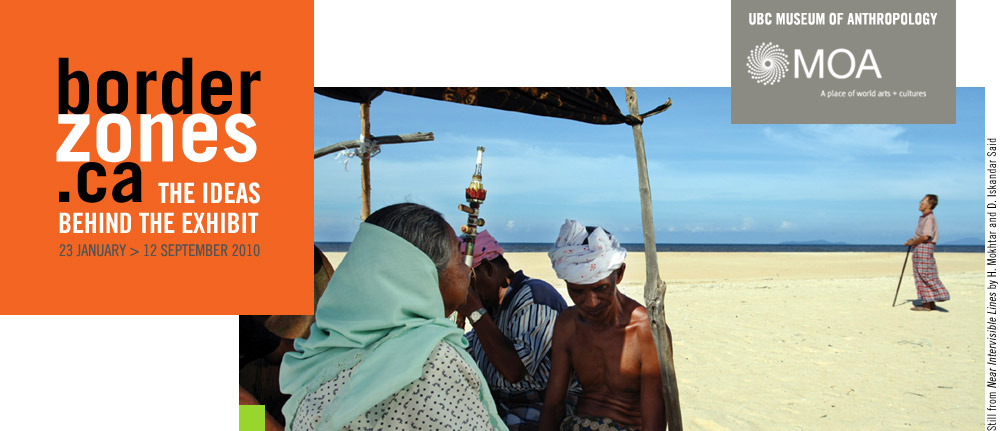
Still from Near Intervisible Lines by Hayati Mokhtar and
Dain Iskandar Said
|
|
|