|
 |
|
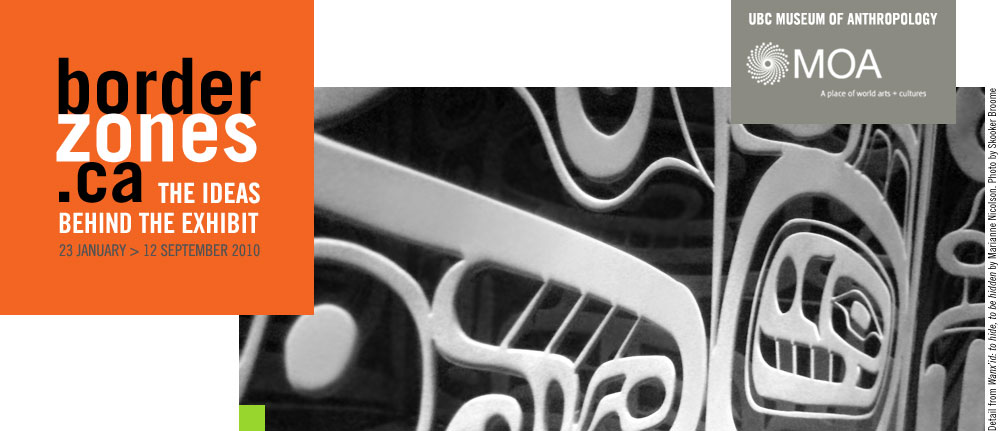
I love the idea behind Marianne Nicolson’s piece, Wanx’id.
The hidden meanings and subtly inscribed knowledge contained in
our traditions of thought and speech and ceremony should never be
presented facilely or made accessible to every gaze cast upon them.
In mainstream aboriginal art, this is all too often the case. As
I see it, Nicolson’s work is about authenticity and import
and utility on our own terms and for our purposes, not to satisfy
someone else’s needs and expectations. It also points to the
fact that some cultural boundaries are there for good reason.
I fear that too many artists and writers today see their work as
being part of a service industry, satisfying consumerist impulses
and providing non-aboriginal society with a connection to the land
it occupies and to a history and a culture it doesn’t itself
have. The galleries, boardrooms, public spaces and living rooms
of Canadian capitalists, increasingly stocked with pricey and technically
brilliant aboriginal artwork, to me evoke the spirit and intent
of the old British trophy room, overflowing with impressively arranged
artifacts of conquest. As in past eras of colonialism, having these
things in one’s house or on one’s body signaled not
only ownership of the object itself, but possession of that culture
and those people.
Being colonized means that you are not your own person, and that
what was formerly yours has become the subject of another’s
desire and authority and had its meaning absolutely transformed.
It is nothing less than the loss of control over who accesses your
knowledge, your culture, your land, and your body—and for
what purpose. Your world and your self are assimilated as property
into the regime of another’s power. This is what Canada means
in its past and present for us.
|
 |
|
 |
|
The adoration of aboriginal art today doesn’t signal a
sudden moral enlightenment on non-native Canadians’ part,
nor does it mark reconciliation or the dawn of a post-colonial era.
Quite the opposite. It betrays the desperate need on the part of
the larger society to create some legitimacy to their existence
on this land amongst people whose survival and re-emergence are
obvious reminders of the crimes, frauds, and abuses that form the
foundation of this country. There are plenty of people producing
artifacts and artful products for this market, but the true artists
among us are not feeding the colonial ego or servicing capitalist
desires: they are teasing out and communicating ideas on what it
was and what it means today to be Indigenous in the midst of capitalism.
Derivative carved façades and rote repetitions of old songs
and dances and visual forms are not really art, and to people who
care about the survival of our people they are ultimately useless.
I think art becomes meaningful when it is part of a process of
a human being/artist striving to excavate ancient and suppressed
memories and working with them to regenerate and reinscribe our
presences on the landscape. Notice I didn’t say cultural presence.
That’s because I am not talking about striving for mere cultural
recognition or working to facilitate understanding across cultural
boundaries. I am talking about the land and other creatures and
the spiritual forces that make up our world, what all of these have
to teach us about being human, and once again taking up our responsibility
within this confederacy of beings.
|
|
|
 |
|
Wanx’id speaks to closed spaces of refuge where
immensely skilled and hugely accountable teachers work with meticulous
care to pass on this crucial wisdom. It is truly Indigenous. It
is not concerned with impressing those expecting to be impressed,
or translating meaning to those who assume they have a right to
know everything. In conceiving and executing her work, this human
being/artist has made a strong statement against aboriginality as
a placid and cooperative posture.
Our art is our life, and to me the power of Marianne Nicolson’s
work is not on display in drawn designs or shaped forms. What makes
her an artist in my mind is her conscious engagement with the elements
of her people’s culture and their homeland. The pieces of
wood, the paint on rocks, the arrangements of light all form a constant
chronicle of her continuing journey as a person striving to be a
true human being. The works are affective and beautiful. But her
art and that of any artist is her journey and how she makes us think
and feel about our own lives. In this sense, her work is a powerful
teaching to those of us who are struggling to find ways to regenerate
ourselves and to reestablish our presence in these homelands of
ours, now called Canada.
Gerald Taiaiake Alfred is an author and educator who is committed
to Indigenous peoples’ dignity, freedom and nationhood. A
professor of Indigenous Governance at the University of Victoria,
Taiaiake is known for his leadership and groundbreaking work in
the fields of Indigenous governance and political philosophy. His
most recent book is Wasase: Indigenous Pathways of Action and
Freedom (2005).
Read Visitor Comments Here |
|
|