|
 |
|
Picture this: a severed leg, soaking in blood, locked in a bottle.
It whispers the following:
I think I know where I came from and who chopped me off, but I no longer remember the route that I travelled to arrive here. |
This eerie image captures a moment of ambivalence, displacement,
dismemberment, confusion, and confluence. Contrast this to the celebration
of liminality—a state of being in-between, or suspended—as
an inevitable part of diasporic existence. As Shanaathanan’s
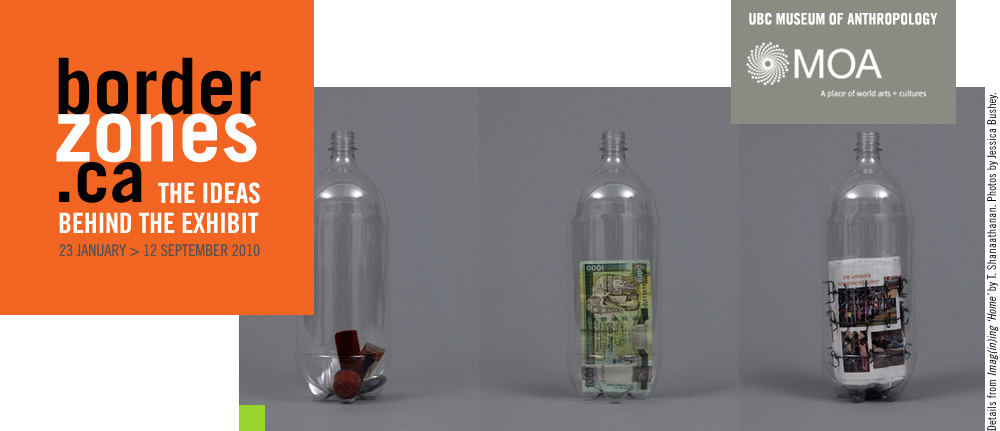
installation Imag(in)ing ‘Home’ (2009) implicitly
suggests, not all displacements are the same.
Many Tamils have been deeply affected by more than 20 years of
conflict between the Sri Lankan government and Tamil Tiger rebels.
Forced displacements create a tormented diaspora, and the pain and
trauma that accompany the Tamil diaspora will linger for a long
time. Perhaps this will pave the way for transnational linkages
between “home” and “adopted home.”
I first encountered Shanaathanan’s paintings, littered with
haunting images of tortured landscapes, in 2004 when I visited his
ancestral home in Jaffna, Sri Lanka. It was a privilege to see his
paintings, since some had not yet been exhibited. Those images are
a testimony to, and lament of, the brutal civil war that has left
indelible scars on the Tamil people’s body and psyche, land
and landscape, life and culture.
Shanaathanan’s latest installation Imag(in)ing ‘Home’
metaphorically suggests that the Tamil people’s hope of living
may now be confined to internment camps behind barbed wires, surrounded
by high-security zones, and deprived of returning to the sea—a
landscape from which the people are forced to migrate to become
part of an ever-growing diaspora. There are messages and, more importantly,
lives in Shanaathanan’s bottles. Questions of how Tamil identity
is articulated by the diaspora are vividly and poetically answered
in this work. Sherds of pottery, a ragged piece of cloth, an old
certificate of birth, a flag, a piece of barbed wire, and a kaampu
chatthakam (curved knife for basket making) are only a few
of the many objects loaned by community members. Each articulates
and memorializes a different facet of being Tamil.
“The resulting installation,” explains the artist,
“is a collage of diverse and contested identities, of memories
and histories of a lost homeland, and of different mechanisms of
home making.” Imag(in)ing ‘Home’ is also
a meditation on how people living in diaspora create an imaginary
idea of ‘home’ in their minds.
|
 |
|
 |
|
I have always maintained that the connection formed between identity
and land is inadequate to understanding Tamil identity, which, unlike
other identities in South Asia, was long centered on language rather
than territory—and which must also be considered in terms
of the social, political, historical, and literary production of
the Tamil people.
Classical Tamil poetry (100 BCE - 300 CE) offers some
clues to "Tamilness" and how it may be understood historically.
Such poetry identifies five landscapes—called thinai—and
their corresponding cultural, ecological, economic, and emotional
attributes. These landscapes include mountains and surroundings,
forests, agricultural and pastoral lands, deserts, and the sea and
coast. A thinai is a landscape and genre infused with several
layers of meaning and identity—and central to the idea of
thinai is the organic linkage of time, space, landscape,
and emotion. I maintain that the thinai are the cultural
sites that form the basis of Tamil identity, today as in the past.
The major element or landscape that is missing from this classification,
however, is the cityscape or urbanscape. It is in the modern Tamil
diaspora that the city becomes a central metaphor and location.
The attachment to one's landscape and Ur (village/place
or region where one was born) may help explain why regional and
Ur identities have become so strong among Tamils in the
diaspora. There are, for instance, more than 250 Ur sankangkal
(Tamil home-village associations) in Canada today.
For me, Shanaathanan's paintings and installations evoke in a simple
but powerful way this complex reality of being, belonging, and displacement.
Shanaathanan and I have begun a dialogue with one another through
his art and my poetry: some of his work was inspired by my writing,
and some of my poems by his art. The following poem—The
story of a severed leg—is a result of this creative interaction.
The story of a severed leg
I am writing the story of a severed leg.
A road that begins in the mountains
runs through this barren land
to the city,
now lies distraught.
The story of war mixed with blood
in scattered fragments
like restless ghosts,
follow the road in grief.
The tears of wounded trees
settle on the marks
left by vehicles
of well-meaning NGOs.
The dust covers the tears,
indifferent, like an undertaker
covering the body
of an unclaimed corpse.
Dismembered by war,
the road survives;
I saw
where the road forks,
a half-broken milestone;
on it sat
a skull.
On this barren road
consumed with thirst
turning toward the forest,
I saw,
beneath the Palai tree
a severed leg.
A thousand stories
rose to fill the forest
from that leg
lying without protest.
Those stories displaced
the wondrous tales and visions
the forest acquired at birth,
long before memory’s time.
The displaced stories and beliefs
in diasporic lands
in the temples of Tamils,
in their myriad lives,
now hang,
embodiments of sin.
Beneath those,
compassion in darkened rooms,
the irresponsibility of distance,
I see
in these walking corpses.
I saw
in the forest engulfing
pain, courage, sorrow, oppression,
despair–the severed leg.
I saw,
on the tomb of my dreams,
scattering its stories
in silence,
the severed leg.
|
(This poem was first published in Tamil after the 2004 Indian Ocean
tsunami. It was published in English in Wilting Laughter: Three
Tamil Poets. Translated and edited from Tamil by Chelva Kanaganayakam.
Toronto: TSAR Publications, 2009.)
R. Cheran is an Assistant Professor in the Department of Sociology
and Anthropology, University of Windsor, and a poet and writer in
Tamil and English.
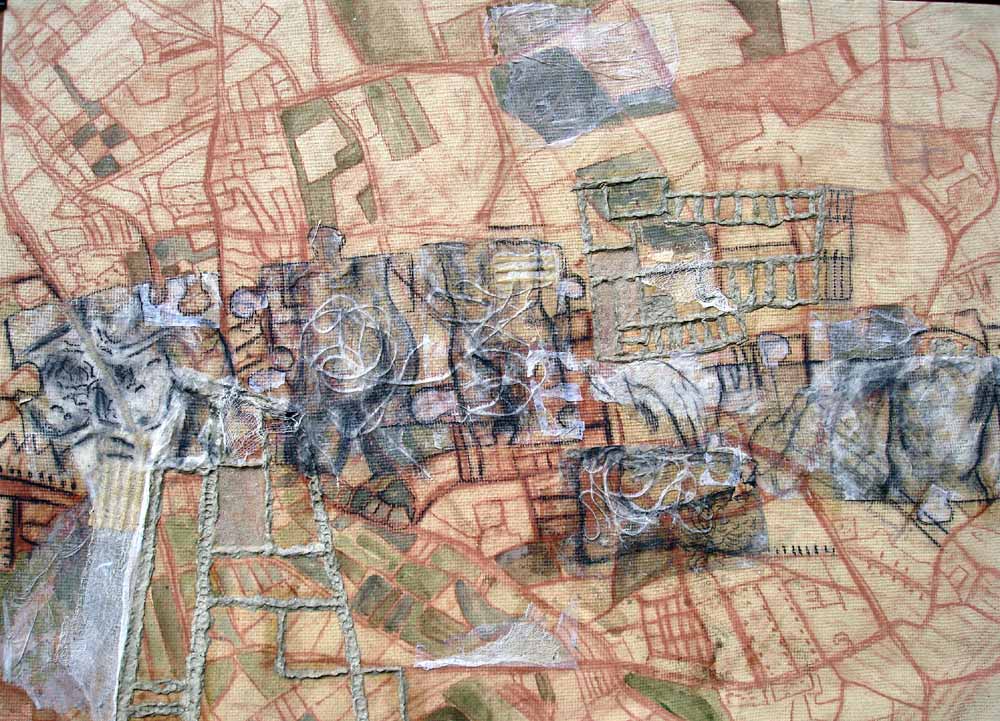
Art work credit: Dislocation (2003) by T. Shanaathanan
Mixed media on paper
|
|
|