|
 |
|
My first encounter with Laura Wee Láy Láq’s pots was in 1990. Her solo exhibition was on view when I became director of what was then the UBC Fine Arts Gallery, located in the basement of the now demolished west wing of the old Main Library. That these spaces no longer exist and that the institutions they housed have new buildings and new names (Main Library/Barber Learning Centre; Fine Arts Gallery/Belkin Art Gallery) is incidental. But it reminds us that pots—especially of the kind that Wee Láy Láq makes—involve us in thinking about longer temporal arcs than those that encompass the lives of buildings, galleries and libraries.
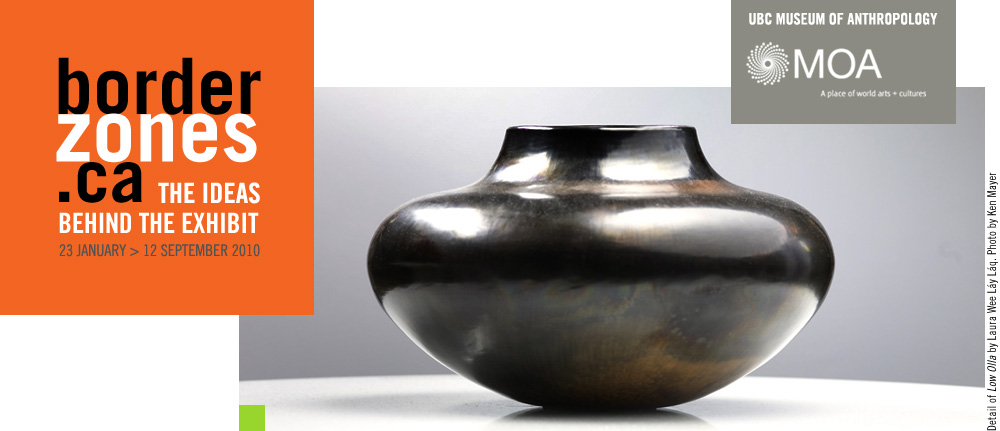
It was also in 1990 that the Museum of Anthropology purchased a Wee Láy Láq pot to be the contemporary connection to the then recently housed Koerner Collection of central European ceramics. It seems to me that while the Koerner Collection itself does not appear to do much work and is content to sit in its vitrines listening to Baroque music, Wee Láy Láq’s Hawk Olla is asked to perform the heavy task of bridging the otherwise completely unrelated collections of Northwest Coast art to the Bohemian pots. It does this work because Wee Láy Láq is local—she is a member of the Stó:lō First Nation—and she has ties to indigenous North American pottery traditions that, in turn, have ties to the universalizing potpourri envisioned by the Hamada-Leach-Yanagi circle.* Thus her pot is asked to be a kind of segue from the carvings of the museum’s Great Hall to the pots and tiles of the former Czechoslovakia. It can perform this task because it really is part of an international twentieth-century dialogue that proposed a renewal of old craft traditions through hybridization and innovation. |
 |
|
 |
|
Although I only visit Wee Láy Láq’s pot in the Koerner collection infrequently, I can call forth an image of it in my mind from the first time I saw it. I recall marveling over the “accidental” landscape suggested by its smoky, burnished surface and its tall stance. Wee Láy Láq’s pots have a classical, generous repose. The olla style she often creates has its roots in the shapes of gourds, so her sense of form and containment is tied to organic shapes but also to notions of form as an achievement and an arrival at balance. It is difficult to make a round object that has a stance, that won’t tip. While the surfaces are all polished blacks, browns and grey fogs set in stone, the insides are a charred black void. Some pots are rimmed with petal, horn or talon-like appendages that look like the artifacts of some ancient, unknown culture. They have their own look and style based on Wee Láy Láq’s study of organic form. Her technique, moreover, is unusual. Like the great potters of the American Southwest, she builds rather than throws a pot. Yet she builds with flat straps of clay, while traditional hand-built pots are traditionally built with coils. The flat-strap technique was taught to her early in her career by Fred Owen (Kybor Dancer) at Douglas College in the early 1970s. As far as we know, the flat-strap technique is not found in any traditional ceramic culture. By building an olla in this way, Wee Láy Láq is able to construct large pots that have balance and durability. When she makes elaborately serrated rims that resemble opening buds, she uses vertical straps. Again, this is a wholly modern technique, developed by Wee Láy Láq herself. |
|
|
 |
|
As contemporary as they are, Wee Láy Láq’s pots enter a dialogue with ancient tradition, especially that of the Pueblo of San Ildefonso, New Mexico. It was in this community that Maria Martinez (1887-1980), at the urging of anthropologist Edgar Lee Hewett, rediscovered the lost technique of black-on-black pottery between 1913 and 1920. It is worth noting that while the recovery of this technique would bring fame to Martinez (Bernard Leach, Soetsu Yanagi and Shoji Hamada visited her in 1952, recognizing in her a kindred spirit and a necessary connection for their vision of a world pottery), it was spurred on by the needs and desires of the ethnographic museum. Wee Láy Láq’s connection to San Ildefonso is through the potter Blue Corn (1920-1999). A protégé of Martinez, Blue Corn specialized in traditional Pueblo polychrome ware and is celebrated for her technical innovations. She and Wee Láy Láq met in 1980, when Blue Corn was conducting a workshop on Vancouver Island and Wee Láy Láq was studying with Tony Hunt. Maria Martinez, who would die that same year, summoned Blue Corn before she left for Canada and spoke of her dream that Blue Corn would meet someone on this trip who would be important to her. That person was Wee Láy Láq. The two became close friends, with the result that Wee Láy Láq made frequent visits to San Ildefonso. Wee Láy Láq’s affinity for the pottery traditions of the Pueblo is seen in her choice of the olla as a basic form, her preference for hand-building rather than the potter’s wheel, and her burnished surfaces. As well, she has a personal connection to one of the greatest potters of that tradition. But her pots relate to the natural forms she finds here. Recent rims look like mountain ranges.
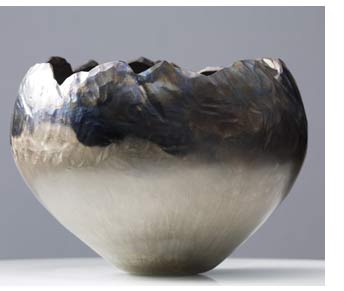 |
Mountain Olla, 2009
by Laura Wee Láy Láq. Photo by Ken Mayer |
Wee Láy Láq’s own account of her practice reminds me of the philosophical and ethical dimension of pot making that was espoused by Yanagi and Leach. It is both meditation and alchemy:
For me clay not only allows me to express my hopes and fears, but also gives me an opportunity to feel at one with nature. 'No Mind' is a common Buddhist expression which helps to describe the feeling that I attain while working with clay. Clay gives me a sense of harmony and peace. For working with clay stops my internal dialogue. To take earth, give it personal expression, smooth it with a stone, give it to the fire, changing it from earth to stone, then embedding the clay into the dust of trees and making it vulnerable to the natural elements, completes a cycle—a cycle in which I am proud to play a part. |
Besides the pot in the Koerner Ceramics Gallery and the pots included in the exhibition of contemporary art, Border Zones, there are now four other Wee Láy Láq pots to be found in the Museum of Anthropology. Three are displayed in the new Multiversity Galleries: one in a case of European artifacts, and two in a Coast Salish vitrine highlighting “blended traditions.” While there are many objects in this visible-storage area that might not be considered “ethnographic” because they are also authored works of art (Bill Reid, Kawai Kanjiro, et al.), Wee Láy Láq’s pots are oddly situated there if they are meant to represent a cultural tradition. They are part of the network that includes the revival of tradition, but they are not attempts to recuperate a specific tradition. Rather, they are an independent and contemporary investigation into the possibilities of the hand-built pot as a holistic activity—one that connects the maker to nature and the long continuity of human culture.
* Bernard Leach, Soetsu Yanagi and Shoji Hamada were all instrumental in establishing the Mingei movement in Japan. Borrowing from the Arts and Crafts ideas of William Morris, the Mingei enthusiasts set out to celebrate, preserve and restore the folk arts of Japan in the 1920s and 30s. Leach, who with Hamada’s help established a pottery in England in the 1920s, sought to revive the pottery traditions of Europe and to renew ceramic tradition by blending East and West. For this circle, ceramics were a philosophy and a way of life.
Scott Watson is Director/Curator of the Morris and Helen Belkin Art Gallery and Professor in UBC’s Department of Art History, Visual Art and Theory. Watson has published extensively in the areas of contemporary Canadian and international art. In 2004, he co-curated Thrown: Influences and Intentions of West Coast Ceramics, from which his current research project and upcoming publication on British Columbia’s studio-pottery movement emerged.
|
|
|