|
I grew up in the border zone between Catholic and Protestant in Northern Ireland, and while it’s uncomfortable at times, it’s by no means all bad. Yes, we must be mindful that the liberal democracy project can only welcome aboard things that it can understand. Life-worlds which in the past were actively extirpated as ‘primitive superstitions’ and ‘inefficient economic practices’ are now merely ignored or starved. We have only to recall the late Alan McEachern, who as Chief Justice of the BC Court of Appeal dismissed the Gitxsan and Wet’suwet’en claim to millennia of civilization as a fiction encouraged by anthropologists who, of all people, should have known better. McEachern’s use of Thomas Hobbes’ words to characterize life before European contact as “solitary, poor, nasty, brutish and short” illustrates the inability of some to entertain a civilization radically ‘other’ than their own.
As Dana Claxton implies in her review of Border Zones (on this website), the history of museums and other cultures is not happy. Much was destroyed as ‘heathen,’ or was stolen.
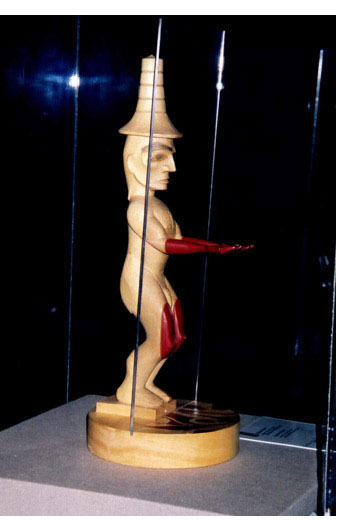 |
Museum Man by Shawn Hunt. Image courtesy of Pam Brown. |
Much more was ‘acquired’ under dubious circumstances. A ‘double theft’ occurs when the ‘artifact’ is translated into the language of academia, with (at least recently) a nod to ‘informants’ or ‘collaborators.’ The same ‘double theft’ applies when the property of other cultures is patronized as ‘crafts’ or classified as ‘fine art.’ Mario Vargas Llosa describes anthropology as taking up the job where the colonists left off (El Hablador). Yet ‘fine art’ is particularly problematic—and yesterday’s fight, for all but a few holdouts. In her book Borderlands/La Frontera, Gloria Anzaldúa distinguishes art which comes alive in performance from art in the Western tradition, where it is understood as self-sufficient, telling its own story, and recognized by placement in a museum. An evocative illustration is the sculpture Museum Man by the young Heiltsuk artist Shawn Hunt, in which a human figure emerges through a sheet of plexiglass, the arms and knees coloured and alive, the rest unpainted. The supreme irony is that the classic museum response to this work would be to encase it in an even larger plexiglass box. Anzaldúa wonders about the status of an ‘artifact’ in a museum: is it alive?
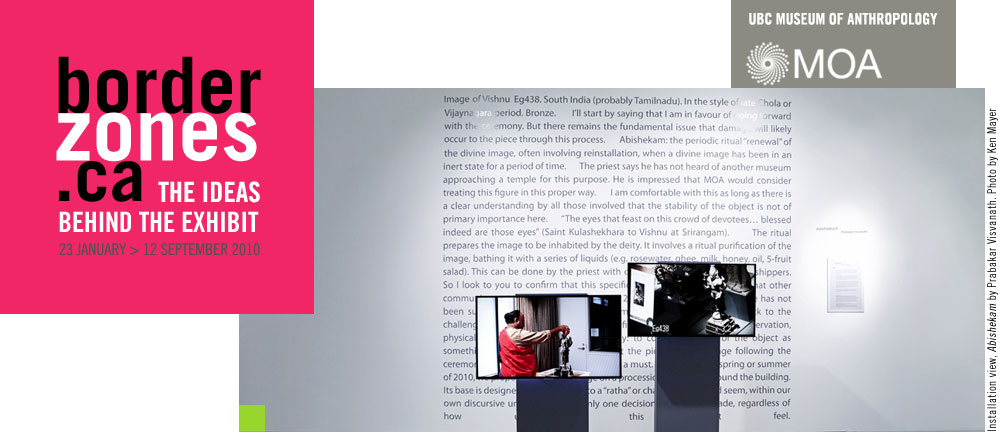
This is the question raised in Prabakar Visvanath’s Abishekam, which bristles with tension between the museological/conservatory and performative life-in-community of the deity—the source of much of Claxton’s unease. Yes, the irruption of the sacred is uncomfortable in a secular setting—almost as uncomfortable as free-market pene/tration into a sacred setting. It is a discomfort which we—the ones living the revenge of the money-changers who Christ cast out of the temple—desperately need. A discomfort which is inevitable as the Enlightenment’s ‘de-sacralization’ of the world collapses with the myth of the conquest of ‘nature.’ I suggest that the museum, recognized as a signifier of the separation of people from things sacred to them, is a fitting place for the meeting of communities, artists, priests, and scholars. It is a discomfort which we all need as much as the reminder of past and present injustices and barriers of comprehension so powerfully stated in Edward Poitras’ Cell.
There is no ‘privileged’ ground from which to pass judgment on these issues: not the academy, not the pulpit, not the repositories of ‘fine art.’ In a world where all truth claims are suspect, what remains is to develop descriptions that are useful and meaningful to us in our time, and that help us to better understand not only each other, but ourselves. With its exhibition Border Zones: New Art across Cultures, the Museum is finally taking its role seriously.
Nigel Haggan describes himself as an aging PhD candidate exploring ways to include the sacred in our uneasy relationship with coastal and marine ecosystems.
|
 |