|
Border Zones provides several points of
physical entry. One can enter the contemporary art exhibition through
the Great Hall of Northwest Coast totems, or through the open-concept
study rooms (Multiversity Galleries) with aboriginal and other worldwide
collections, which reach the main gallery through the display of
Asian artifacts. Either way, the viewer is gaining entry through
“artifact”—and perhaps this is where it becomes
apparent that as a viewer, you are in a museum of “artifacts.”
The first work I encountered in Border Zones, “law
poles” by Ron Yunkaporta, are both beautiful and confusing.
If one does not read the didactic explaining what purpose these
magnificent poles have, they could simply be viewed as “artifacts”
from long ago. The gallery is dark with low ceilings and has a very
traditional museum sensibility.
John Wynne’s audio and photo-based installation, Anspayaxw,
could be mistaken for a National Geographic research project, but
on a deeper reading it became apparent that this work is about what
goes on outside of the museum space. The audio consists of tribal
members of Kispiox speaking in their language about their lived
experiences. The audio with the large photos of the speakers, the
spaces in which they were recorded, and other images from the community
are hung in sort of a circle. Again, the dark and low-ceilinged
exhibition gallery contributes to an institutionalized view of the
work.
The river of white boats in Gu Xiong’s Becoming Rivers
leads viewers into the rest of the exhibition and into the new wing.
It can be read in many different ways. The small, plastic boats/ships
could be seen as the colonist’s ship leading you away from
research-based work and into a new beginning. Do the white boats
represent death in traditional Chinese colours? Are they bringing
death, or are they already dead? They are, after all, plastic. Hundreds
of the boats are located both inside the gallery space, hanging
from the ceiling, and outside on the grounds. They are ephemeral
and threatening at the same time.
The new gallery space of contemporary art is packed with works
ranging from video installation, pottery, and sculpture to more
video installation. The large four-channel video installation by
Hayati Mokhtar and Dain Iskandar Said, Near Intervisible Lines,
dominates the far wall, yet allows the other works to exist, perhaps
because of the soft, pastel hues of the Malaysian coast it represents.
With a horizon line in the distance and aqua blue sky, it’s
almost like a beachfront property, and one can gaze and gaze into
the distance—so much so, it may be a distraction from other
works in the space.
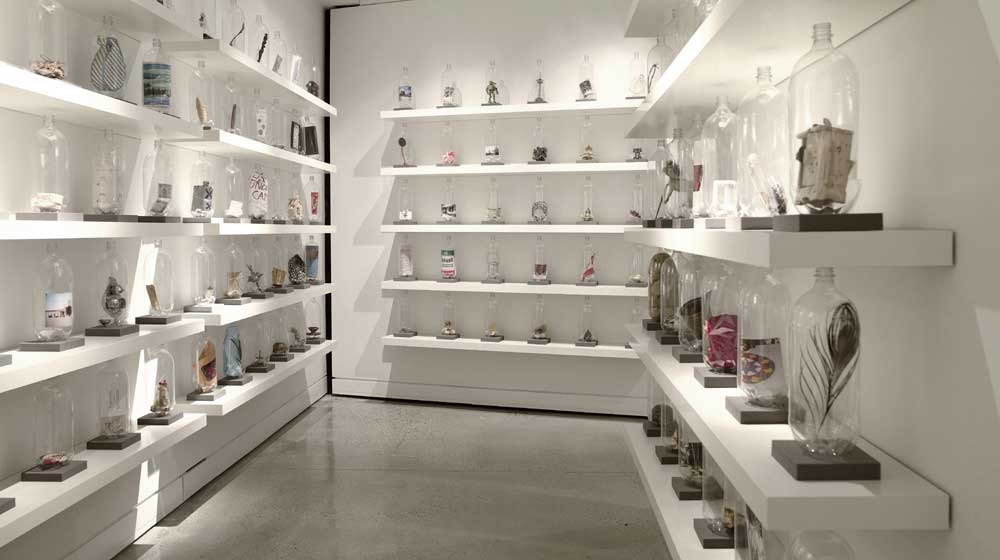
Sri Lankan artist T. Shanaathanan’s collaborative work with
the local Sri Lankan community, Imag(in)ing ‘Home’,
is reminiscent of old-school museum practices of collecting everything
from a culture and then displaying the objects behind plastic or
glass. These objects are from the everyday and ready made, carrying
great depth of meaning in relation to Sri Lankan aesthetics, kitsch,
iconography, and experiences as newcomers to Canada. This work,
too, was about what goes on culturally outside of the museum.
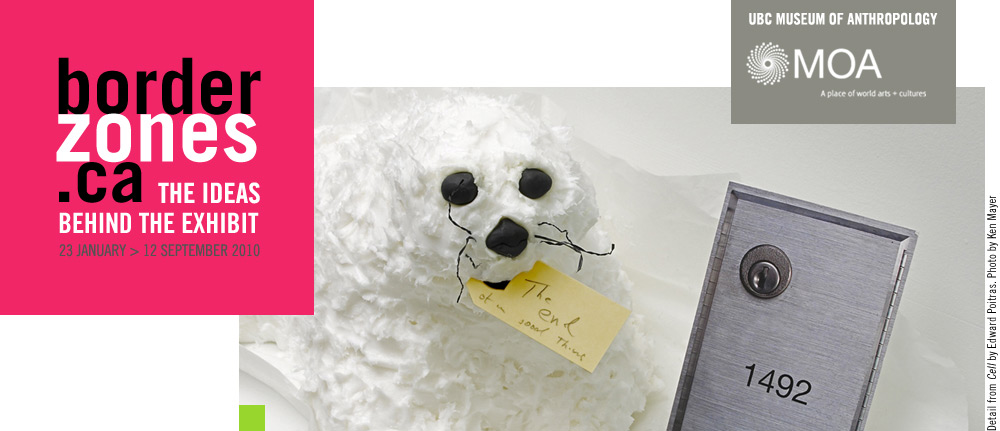
The work I was most challenged by, in a good way, was Cell,
by Edward Poitras. The work considers confinement, justice, brutality,
and social autonomy, as well as social responsibility. To know that
thousands of aboriginal people are imprisoned in institutions and
by a state that wants to make tougher jail penalties for offenders
rings true in the small, white cube Edward constructed. Poverty
and the structural dehumanization of aboriginal people have fueled
the jail industry in this country. In some ways this is the new
residential school for those who went from residential school to
jail to a healing centre, then back again to jail, and for their
children on the same journey, and their grandchildren in juvenile
hall, moving to jail, to treatment, to jail, to hopefully figuring
it out. There are many intellectual entry points into this work,
and the starting point for Edward Poitras was the reality that Leonard
Peltier remains in jail. He is in the cell: the controlled and monitored
space. The institutionalization of the containment of indigenous
bodies, and being numbered as a human being, are larger issues that
Edward’s work ponders.
A final work, Abishekam, is a video documentation of a
ritual in which a Hindu priest dresses a deity figure. I had to
stop watching halfway into the video, as I was not prepared for
ritual and felt awkward witnessing something of this magnitude that
I didn’t agree to. This action was a museum “first”
and really quite a radical move to have a non-museum professional
without white gloves touch and even pour milk and other liquids
on the statue. But as a ritualist myself, there is a time and place
for ceremony, and I’m not sure a museum is an ideal site of
sanctity in which to view an ancient ritual on a video monitor.
Beside the video, there is a live feed on a monitor of the actual
deity in the “artifact” section of the museum. A lovely
deity that deserves to be dressed and honored—and perhaps
released and placed back into its original home so the people can
engage with her manna.
|
 |