|
The most provocative art pieces in Border Zones: New Art
across Cultures are ones that consider the borders implicit
in the space of the museum itself. Gu Xiong’s mixed-media
installation Becoming Rivers physically extends beyond
the walls of the museum and then travels in, above, and through
spaces. Rosanna Raymond’s piece Cling to the Sea
was accompanied by a performance titled SaVAge K'lub that
literally travelled through spaces in the museum to address the
potential of revitalizing relationships between objects and originating
communities. Prabakar Visvanath’s collaboration with MOA staff
reveals the potential for the simultaneous status of a secular artifact
within the museum and a sacred relic animated by ritual practice
from without. But it is Cell by Edward Poitras that most
radically interrogates the space of the museum through tactics that
include placing both a post office and a prison cell within the
walls of the Audain Gallery.
The artist’s statement on the wall label for Edward Poitras’
installation asks the question, “And why is there a post office
in the museum?” thus inviting us to contemplate the spaces
of the museum, the institution, the prison cell, the reserve, the
nation, the world, and the galaxy as cells that are distinct but
at the same time are overlapping, intersecting, and embedded. Through
the label, we are also informed that “…Coyote meanders
off, stage left.” Coyote, the inventive but mischievous trickster,
is the artist or protagonist himself; his departure is a provocation
to the viewer to step in and engage with the piece. There is a mystery
and we become detectives investigating it.
|
 |
|
 |
|
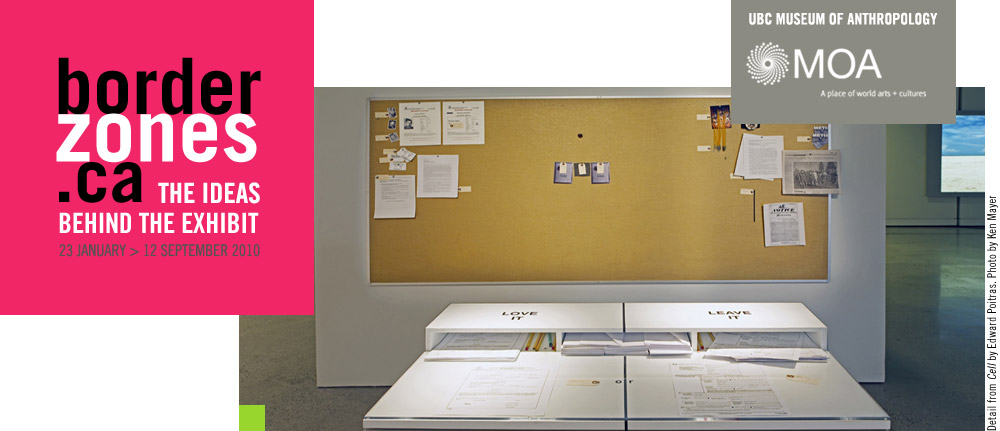
The clues Poitras leaves include dates, newspaper
clippings, hand-written notes, missing person signs, photographs,
a tall desk with citizenship applications, a glass vase filled with
pins, and a seal pup. A sign invites us to take sides: “Love
it or Leave it” is the first clue to the spatial operations
at play in the piece. Printed onto the tall desk complete with writing
implements, the viewer is asked to respond by filling out corresponding
renunciation of citizenship forms. This is but one of a series of
delineations across implied spatial jurisdictions that Poitras provokes
us to move through and beyond.
Casually pinned to the centre lower right of a corkboard hangs
a black strip of paper approximately ten inches in length. A craft-paper
tag identifies the black strip as “a piece of border.”
Other mechanisms of spatial delineations include the presence of
a surveillance camera, and a small white room (a prison cell) with
a dotted line and ‘X’ painted on the floor at the threshold.
At each step, we are compelled to make choices about which spaces
to engage and transgress. From the clues given, the viewer is made
aware of the political dimension of the spatial jurisdictions to
which Poitras wishes to draw attention. An example of this is the
December 8, 2009 newspaper clipping with the story about how the
Mohawk community of Kahnawake, Quebec, took down their barricade
against RCMP and Quebec police for the Olympic Torch Relay. While
reserve land for First Nations people in Canada is simultaneously
a “cell” and sovereign territory, the fuzziness of this
dual political jurisdictional system has incited conflict about
space and rights.
The overlapping implied spatial jurisdictions within the installation
are accompanied with elements that invite and repel viewers, forcing
us to confront false dichotomies but to always choose. Perhaps the
best example of this is within the small white room that we have
to cross the dotted line to enter. Within this room is a television,
some photos pinned to a wall, and two glass objects: an enclosed
display case and a bowl. The enclosed display case contains curious
artifacts that include a homemade WMD (weapon of mass destruction)
and small seal pup that looks like it has been taxidermied, but
is actually made of lard. The lard seal is displayed in the language
of the museum; it is rarified and held away at a distance for venerable
viewing. The easily overlooked glass bowl located across from the
display case, however, contains pins that reference the Olympics
and the Australian athlete Peter Norman who, on the medal podium
at the 1968 Olympics, controversially wore a pin to show solidarity
with the Black Panthers. Mounted at hip-height, the glass bowl tempts
us to take a pin as if it were a sweet from a candy jar. Our confrontation
of the two glass objects that both repel and invite us gets recorded
on a surveillance camera, thus adding another layer to the inscription
of dislocations and divisions onto the space of the installation.
|
|
|
 |
|
The politically charged, surreal investigation set
up by Edward Poitras demands an active viewer who asks questions
and is challenged to put the pieces together, exploring personal
and public boundaries in the process. With the artist absent, the
exhibition demands that our individual knowledge and perspective
is brought to the act of looking, thus enriching the piece with
the creation of links and narratives overlaid onto the enigmatic
space. However, it would be misleading to say that Poitras engages
our vision only; his work actively engages our bodies too. We are
challenged to physically occupy the museum as we may have never
before: making connections across time and scales and relating the
inside of the museum to the outside and the outside to the inside
until the distinction is no longer clear.
Mari Anna Fujita is an Assistant Professor at the University of
British Columbia School of Architecture and Landscape Architecture,
and is Principal of Fujitawork, a Vancouver-based design studio.
Mari’s work is focused on the spatial and cultural effects
of globalism. Her design studios and seminars explore emergent forms
of urbanism, with a focus on Vancouver and other cities experiencing
rapid growth.
|
|
|