The Museum of Anthropology celebrates its
new expansion with a multifaceted show that moves boldly across
borders.
As curator Karen Duffek walks through the Museum of Anthropology,
she takes a strategic detour. On her way to previewing the exhibition
Border Zones, she descends a ramp opposite Bill Reid’s famous
sculpture Raven and the First Men, and guides us through MOA’s
gleaming new Multiversity Galleries. Like the old visible storage
facilities they replace, the Multiversity Galleries provide the
public with visual access to MOA’s rich and diverse collections.
The organizing principles behind the displays, however, have shifted
significantly.
Duffek, who is curator in the areas of contemporary visual arts
and Pacific Northwest cultures, has a particular insight here. In
addition to participating in the reorganization of MOA’s permanent
collections for public display, she is responsible for bringing
together Border Zones: New Art Across Cultures, which officially
opens at the museum on January 26. This exhibition of contemporary
international art is part of the series of events and performances
programmed to mark the completion of MOA’s two-year expansion
and renewal project, A Partnership of Peoples.
“We’ve been working with many of the communities represented
to completely rethink the way in which the collections are organized,”
Duffek says of the Multiversity Galleries. “You’ll be
able to encounter different knowledge systems through the entire
space.” The wealth of cultural objects on display—16,000
of them—includes everything from Kwakwaka’wakw mourning
masks and Inuit kayaks to Samoan bark paintings, Chinese opera costumes,
and South Asian puppets.
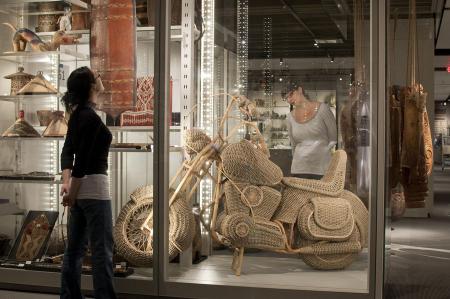
Duffek pauses in front of a row of glass-fronted cases filled with
Coast Salish and Interior Salish baskets. “Here, things are
arranged by family groupings, village, and community,” she
says. “We’ve had many basketmakers coming in and working
with us on how things should be organized in a way that makes sense
to the community.”
Similarly, she says, MOA staff have collaborated with residents
of Alert Bay and Kingcome Inlet to organize MOA’s stellar
collection of Kwakwaka’wakw masks. “The masks are arranged
by ritual order—the order in which things appear within the
potlatch.” Duffek pauses, then adds: “A lot of the discussion
here is, ‘How would you reconcile indigenous values with museum
desires?’ ”
Two galleries, one old, one newly renovated and expanded, have
been designated for temporary exhibitions. These are where Border
Zones is being installed. Surveying the work of 12 international
artists, the show includes ritual aboriginal sculptures by Ron Yunkaporta
of Australia, a four-channel video installation about place and
people by Hayati Mokhtar and Dain Iskandar Said of Malaysia, and
a mixed-media installation that creates a dialogue between the Yangtze
and Fraser rivers, by Vancouver artist Gu Xiong.
It was important, Duffek says, that Border Zones connect with the
Multiversity Galleries and the spirit of the museum’s renewal
project. “We wanted to ensure that the opening exhibit wasn’t
something that just stood by itself in a little white box,”
she emphasizes.
“One of the things that confronts us, as an anthropology
museum, is the idea of cultural boundaries,” Duffek continues.
Some boundaries have disappeared, others are “fuzzy”,
while others still are being reasserted and redefined. Border Zones
addresses these conditions, expressing a diversity of cultural values
and experiences.
The show also looks at the ways in which institutions create cultural
divisions, through designations like “high art” and
“craft”, “traditional” and “contemporary”,
even “anthropology museum” and “art museum”.
“We wanted to cross our own institutional boundaries, too,”
Duffek says.
And as we tour through the show in progress, it’s evident
that the work on view could be exhibited as readily in an art gallery
as in a museum of anthropology. There’s an electronic soundscape
by expatriate Canadian artist John Wynne, with photographs by Denise
Hawrysio, and a mixed-media installation on the theme of home, conceived
by Sri Lankan artist Thamotharampillai Shanaathanan and executed
by members of the local Tamil community. There’s also a disturbing
sound and video installation by Paris-based Tania Mouraud. It smashes
images of a colossal metal dump in northern Germany against metaphors
of genocide.
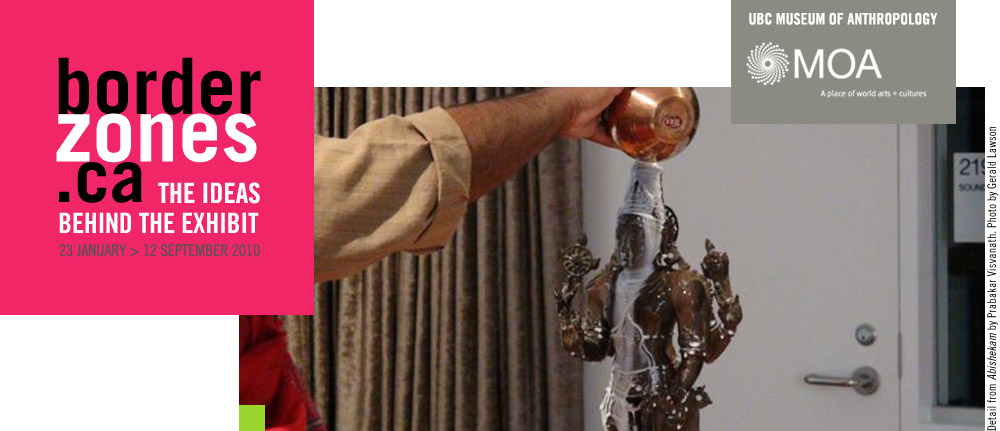
One of the most unexpected installations is Boundary and Translation,
a collaboration between Prabakar Visvanath, a Hindu priest based
at a community temple in Richmond, and MOA staff. Through written
and spoken words and video, this artwork documents the priest “sacralizing”
a 15th-century bronze Vishnu figure from MOA’s collection.
Duffek explains that preparing the figure to receive the deity
involved the priest’s pouring a series of liquids—rosewater,
ghee, milk, honey, and oil—over it, washing it, then clothing
it as for a procession. Museum conservators throughout the western
world were gasping.
“The ritual crosses the boundaries of the secular museum
and the sacred temple,” Duffek says. The act recorded here
also messes up the divide between the old museum’s desire
to physically preserve an object and the new museum’s impulse
to recognize its cultural integrity. “It’s the life
of the object that becomes important.”
FIND
THE ORIGINAL ARTICLE HERE (external link)
Photo by David Campion
|