From an interview with Ron Yunkaporta by Peter Sutton,
at Aurukun, Cape York Peninsula, Australia, 16 July 2006. Sutton’s
interpolations are in square parentheses.
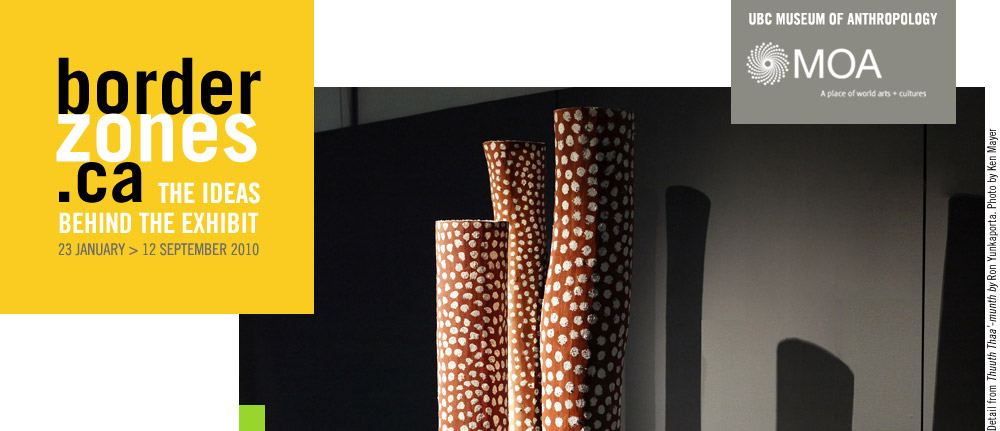
The poles are called Thuuth Thaa’-munth [‘Blunt-ended
fan palm’ in Wik-Ngathan] and Muuy-pak [Bullroarer] in
Wik-Mungkan.
The wood I use for them is thanychel or milkwood, oongketh
or red-leafed cottonwood, or pathath, the cottonwood. Pathath
is strong. The yellow-leafed cottonwood is too soft. I get the wood from
Iith Kaangem (Kaangem Scrub) east of Aurukun, or from Ko’in. There
is no need to ask the Traditional Owners of the sites. We use the Council
truck; it is “work.” I go and cut my own wood.
I use wu’-murrp [red ochre], white and red paint. You
get less payment for white-man paint. I get red paint from Yagalmungkanh,
and white paint from Ikalath on the beach, from the cliff face. Yellow
paint comes from the ground. You tie it up and cook it in paper-bark.
In the raw yellow state it is called ngumpe-ngumpe. [When it
is cooked] it becomes wu’, the red-ochre state. Where we
get it from Yagalmungkanh, you dig the hard ground on the open plain,
pintelang [in the saltpan], and it is soft underneath.
What I make is wiinth tharrn [strongly dangerous or sacred].
You and me, we own that thing. Dad [Victor Wolmby] told me.¹ But
the art people ask me, give good money for fifteen poles, for ten, for
six, for eight.
Without paint it’s just ordinary. When you put on paint it’s
wiinth tharrn [or] ngenych tharrn [strongly sacred].
You might get sore belly, pain in the stomach from them when they are
sacred.
Yoempenhanga maanya: I go make sculpture [literally: make-future-I
image].
Note:
During an Apelech (Wik Aboriginal) mortuary ceremony, the ritual Law Poles,
entitled Thuuth Thaa’-munth (blunt-ended fan palm), ensure
that the spirit of the deceased is present. Afterwards, the poles are
hidden away until they are needed again. Ron Yunkaporta made the three
poles exhibited in Border Zones as a gift for his adoptive brother, the
Australian anthropologist Peter Sutton.
“If you have contact with a sacred object,” says Sutton,
“and don’t have the right standing to do so, or the object
has not been sung to make it quiet, then it can be as dangerous as plutonium.
These poles were sung by Ron so that they would not harm anyone.”
¹ Ron’s natural father, Victor Wolmby, took Peter Sutton
as a son in 1976.
|
































 Artist's
Statement
Artist's
Statement 





