|
       
|
|
 |
 |
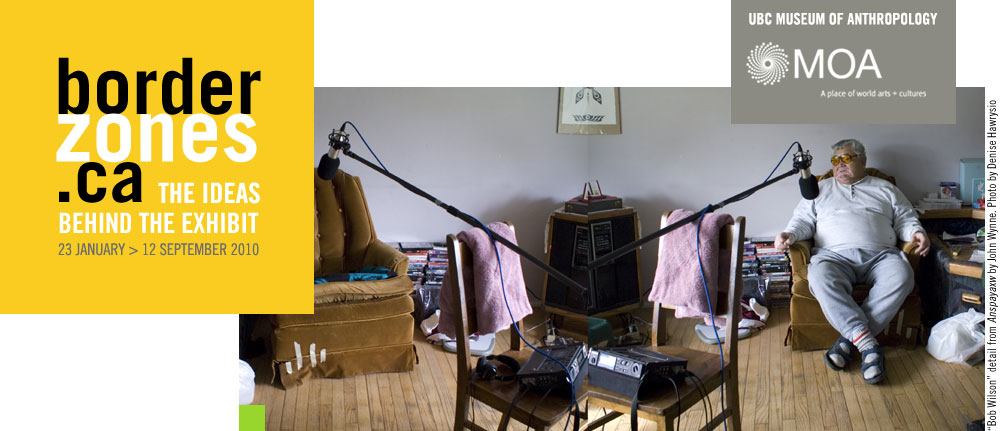
Anspayaxw Anspayaxw (Kispiox) is a small reserve in northern British Columbia where I worked with linguist Tyler Peterson and visual artist Denise Hawrysio to record and photograph members of the Gitxsan community. Their native language, Gitxsanimaax, is one of many seriously endangered languages on the west coast of Canada, an area of remarkable but dwindling linguistic diversity. There are roughly 400 ‘competent’ speakers of Gitxsanimaax, but most of these are middle-aged or older and their average age is rising. Several of the people featured in this installation managed to learn Gitxsanimaax as children despite attending residential schools where its use was forbidden. Such suppression of language by colonizing powers is far from rare: during the 18th and 19th centuries, children caught speaking their native tongue in Welsh schools were forced to wear a block of wood called the Welsh Not, which the wearer would pass on to the next pupil heard speaking the language until, at the end of the day or week, the unfortunate child in possession of it would be struck with it. Language is a primary repository of culture and history, and once a language is no longer spoken, the rich knowledge it carries is gone forever. The linguistic diversity of the world is under threat: there are currently about 6,000 languages spoken now but it is variously estimated that between fifty and ninety percent of these will be gone by the end of this century. The word Anspayaxw ends with a ‘voiceless fricative’, a breathy sound characteristic of the language which influenced the way I have worked with the environmental sounds. All the sounds in the piece are derived from the participants’ voices and recordings I made in and around Kispiox. Sometimes, these sounds are filtered, stretched and resonated, but no other sounds have been added. - John Wynne The artist dedicates this work to the memory of Doreen Jensen (Ha'hl Yee), artist and project participant (1933-2009). Thanks to:
Translations Bob Wilson 1 [in English] Ladies and Gentlemen, the point of interest here is about the old language from Galdo’o – Sm'algyax. Very little of that remains here in the village because our descent moved down to the village over a hundred years ago, over a century ago, and that just about extincts our own language. The accent is different. We use the Anspayaxw – Kispiox – accent, we were born and raised here. I heard my great grandmother speak it, and I tell you that’s real classic. You talk about Shakespeare compared to present English, that’s how it was. Really deep with expression. I love to hear it, I want to use it all the time. I have no problem speaking English. I don’t stutter or sputter around or stamp my feet when I speak it, but I’d much rather use my own. When we get together, guys like us, we don’t speak English – like my younger sister, my brother Roy here. But the next generation is entirely different – as soon as they start speaking, it’s English. They do understand, but they don’t want to know why. We call it Sm'algyax [the true language]. 2 [in Gitxsanimaax] This is what the young people do today. They should learn how to live, how to make preparation for winter, know when it is time for berries, how to plant a garden like people have done in more recent times. There will never be a shortage of fish, as long as the rivers flow. They keep the fish in the ground, in an anuust, an underground pit for food. They lined the containers with bark from the birch tree and the fish is preserved. The little animals cannot get in. The young people today should be taught how to live/survive. They should not sit in front of the TV, playing video games and drinking pop and eating chips. It amazes me that they are still alive – how they eat. They should be told how to eat. That is what is called not listening - when they are talked to they don't listen.
Thelma Blackstock 1 Thelma speaks the words of a funeral song entitled Xsin Naahlxw (Breath). The song belongs to the House of Geel: this recording was made with the permission of the former Geel, the late Walter Harris and its use in this installation is by the kind permission of the current Geel, Catherine Blackstock-Campbell. 2 I want to tell you (all) why I didn’t go to residential school. I really wanted to go. When my siblings, Doreen, Margaret and Walter, came back from residential school after one year I saw how much education they got and I really wanted it for myself. In April 1945 I got ill. I didn’t want to go to hospital, but Dad was insistent because he wanted the doctor to tell us why my neck was swollen. They said it was bronchitis and admitted me right away, trying to get the lump on my neck to go down. Then I got another sickness because I was lying by an open window. I got very skinny. I lost a lot of weight, nearly went blind and couldn’t taste my food. I lost my hair and my nails and a lot of my skin came off. I was an absolute skeleton, just bones. I was sick for a year and that’s why I didn’t get to go to residential school. My heart is still sad about it now, but maybe heaven changed my plans. I’ve had a very good life, even if I’m not educated. It was hard for me when my siblings left me behind. I worked and tried hard to get an education when I left our village.
Gwen Simms 1 Back when I was a young teenager we were hired by the band office and one of the projects was to name the streets. I and my working buddies got together and we saw the list that the government had given the band office and it had names like Spruce Street and Poplar Street and we kind of didn’t like that, so we came up with a different set of street names. We went through and looked at who was living on what street and a lot of the Frog members were living on this one street and we said, well why don’t we name it after who is living there? And so we named that one street Lax-see’l Street, which means Frog clan. Lax-gibuu Street, where all the Lax-gibuus lived – a lot of the clusters had close family members. An-gol Drive – that came about because when we were playing on the softball team that was where we used to run – gol is to run, to run on –we ran on that street and then went down along the beach. The elders made us run in the sand so we could build up our stamina. We didn’t know any better so we just did as we were told. Shaman – it should have been called Halyt Avenue, that’s how we would say Shaman. I’m trying to remember the story that came with that … if I remember correctly from our nigoot [father], he talked about a halyt who lived on that street and he was called on quite a bit to help when people got sick because when he was growing up that was the time of a lot of small pox – that disease was hitting our people quite hard and a lot of the younger kids weren’t surviving, and he helped with quite a few of the kids. 2 Simon Gunanoot – he was a hero, a rebel. What I remember hearing as a small child was that he was a bad person – but this wasn’t coming from our people, and whenever we repeated the negative that we’d heard we were told, no, this is who he was … he lived in the spagaytgan [woods] and did all of the things that people wanted to do but couldn’t because they were herded onto the reserves. He lived a free life, he lived the way he wanted to live, and he hunted, gathered, fished. So in the eyes of my parents, and especially my grandparents, he was a hero because he got to do what they only dreamed of at times. He lived right on the land.
Gary Williams We were out on an ice rink – an outdoor ice rink – all of a sudden we heard the fire bell ringing and there was water squirting all over the place inside the building. We didn’t know that someone had broken into the pantry where they kept all the spam, and there was boxes and boxes and boxes of it. So all the bigger kids, the teens, had broken into this place and they were so disturbed about all the spam for all these years so they started carrying boxes and boxes of it out onto the front lawn and driveway of that big dorm. When the police started coming out, they ran all over these spam cans, so that was quite the thing. Indian Affairs came in and they started meeting and shortly after that things started getting a little better.
Clara and Fern Weget Fern sings her own Gitxsanimaax translation of Bob Miller’s 1933 country song ‘White Azaleas’ Clara: When we arrived at our hotel in Korea we just dropped our luggage off and took a taxi to go shopping and look around. And when I went to pay for my purchases, I realised I’d lost my purse. I wanted to cry, and my tears started to run. The lady in the shop said, ‘Do you believe in prayer?’ And I said to her, “Absolutely, I believe in prayer.’ And she took my hands and prayed for me to find whatever I’d lost. And that is what happened when we returned to the hotel in the evening, at one o’clock. Right away the hotel manager told me that they wanted me to go to the police station. ‘They want to see you and they said for me to bring you myself. I’ll run you and your husband there’, he said. We walked to the police station, and my heart rose when we went upstairs and I saw how many workers there were. We were on the fourth floor, but I saw cars running around. And the man asked me if I had lost my purse and what was in it, so I told him. But I totally forgot that I had hidden some of our money in the purse, and it dropped out. I gave the money to the man and he took us back to the hotel. It’s good that nothing was lost, and I thank heaven for that woman who prayed for us. That’s what happened when we went to Korea.
Barbara Harris 1 Okay, I’ll say it English first because I’ve become sort of Anglicized, you know, so to organise my … [coughs] … gwadza-oos … you know what that means? Dog poo! Anyway, I was born and raised on a reservation called Kispiox , or Anspayaxw. I lived there until I was about five and then I was in and out of hospital with rheumatic fever and TB, and then I went to residential school. To me, as a child, it was just a community, and everybody spoke Gitxsanimaax. They used to have a little medical room, and everything was white and it smelled good to me – the medicines and that. The white person that was looking after it was very nice and he probably had learned a few words in Gitxsanmaax. But I was always in marvel of the difference. The hospital was a missionary hospital but it was segregated. The front part was where the white patients were and the back part was for Gitxsan people. And the fire door was always closed, but being little kids … we weren’t supposed to get out of bed, but sometimes after bedtime we would sneak over and look through the window, and the window had nice white curtains, a table cloth on the bedside table and nice white sheets and fancy pillow cases. On our side, the plaster was coming off the walls and you could see the wooden slats, and the metal beds were nicked – and they were probably poisonous – the paint, you know. The nurses were nice. They used to pick me up and walk me around on the white side to show me off. I had curly hair and I was really cute – I’m not bashful – that’s that they told me! But the other little Gitxsan kids were not treated that way because they didn’t look as … what do you call it? … aesthetic? Well, I had curly hair for one thing, and they had straight hair. Anyway, they never took them around like that. In the two years I was there I began to realise that all the workers were white – you know, I began to notice things like that – but I don’t know what I thought about it. When my family came to visit me they had to come in the back door – native people weren’t allowed in the front door. But now I realise what the impact was of living a segregated life – maybe there’s another word harsher than segregation. In the town we could only go to the worst little Chinese restaurant –Sunrise – it’s still there. And that’s only when we were going to the cannery or coming back. The Chinese community didn’t mingle with the whites or the Indians, but at the Sunrise they allowed us to be there and the old Chinese guys were nice and it seemed welcoming and warm. As time went on, my sisters, Doreen especially, they broke the segregation rule. She had a white boyfriend and my sister Margaret had a white boyfriend. They used to have a dance at Gitanmaax and a different dance for the white people: the way Doreen tells it, they ran back and forth between the two dances and just kind of ignored the restriction. So they broke a lot of ground. The movie theatre was segregated, too, and when they acquired white boyfriends they didn’t know what to do, so I think she said they would take turns going either side until one day you could sit anywhere you wanted.
|
|
 |
 |
 |
 |
 |
 |
 |















 Artist's
Statement
Artist's
Statement 





