 |
Imag(in)ing 'Home'
Displacement is the lasting impact of thirty years of Sri Lankan civil
war and militarization on the Tamil community. Now the dispersed population
is being identified as a “diaspora” outside Sri Lanka, and
as “internally displaced” within Sri Lanka. In the wake of
forced migrations and displacements, the home that is situated in longing
rather than belonging is transformed into a burden of memory and nostalgia.
This installation tries to unpack the complexities and liminality of
the Tamil community in Vancouver by weaving together 300 individual stories
about the idea of “home.” Each personal story or memory is
represented by a mundane or everyday object. Though the resulting installation
is a collage of diverse and contested identities, memories and histories
of a lost homeland, and different mechanisms of home making, the process
of collecting the objects became a kind of rhizomic network linking isolated
Tamil individuals and families, living in different corners of Vancouver,
as a community.
Many of Vancouver’s Tamils—both legal and illegal migrants—passed
through borders, entry points, transits, and checkpoints of different
countries to reach their final destination. Their unpredictable travels
determined the size and nature of the objects they carried. Thus, passage
of travel is a subtext of these objects and this installation. Like the
migrants, the objects, too, went through the surveillance of state and
non-state actors at various points on the journey. Through such travel,
the memory and meaning of objects are translated and altered, and their
transparency and opacity determined.
In this laboratory or museum-like display, individual stories are allowed
to collude with each other, and to transform the personal story into a
public one. Perhaps it will also encourage viewers to imagine “home”
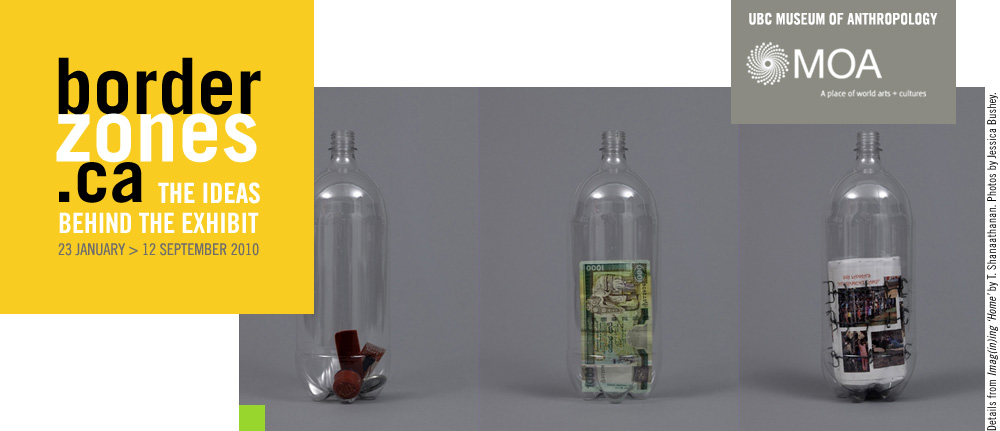
for themselves. The plastic bottles containing each story suggest how
individual images or imaginings are packaged and transacted through commercial,
aesthetic, historical, and political projects, on local and global levels.
They help to transfer the “ordinary” into a “relic,”
and to build a memorial for the public who carried the burden of the war
and the nation. How do the emotional and material boundaries of a diasporic
home exist? And how do they interact and transform each other?
- T. Shanaathanan
Acknowledgements:
Arul Mihu Thurka Devi Hindu Society, Burnaby
Thamil Cultural Society of BC
Tamil Radio, Vancouver
Canadian Tamil Congress, Vancouver
K. Kumaraswamy
C. Premarajah
T. Pretheeban
Shalini Kirupakaran
Sue Nathan
|
 |
FEATURE: Tortured
Landscapes: Tamil Belonging and Displacement by R. Cheran |
 |
|






























 Artist's
Statement
Artist's
Statement 




