 |
Upon reaching the village of Papa and hour's rest was indulged
in, at the chiefs house, where we were regaled with kava and I secured
from him a rather fine wooden dish, as well as a good specimen of
a carved board with which the Samoans usually stencil their native
cloth in different designs; besides this board I obtained the device
by which large pieces of tapa are coloured in the conventional pattern,
which is ingeniously constructed of thick leaves, sewn together
with sinnet.
Frank Burnett, from Summer isles of Eden, 1923 |
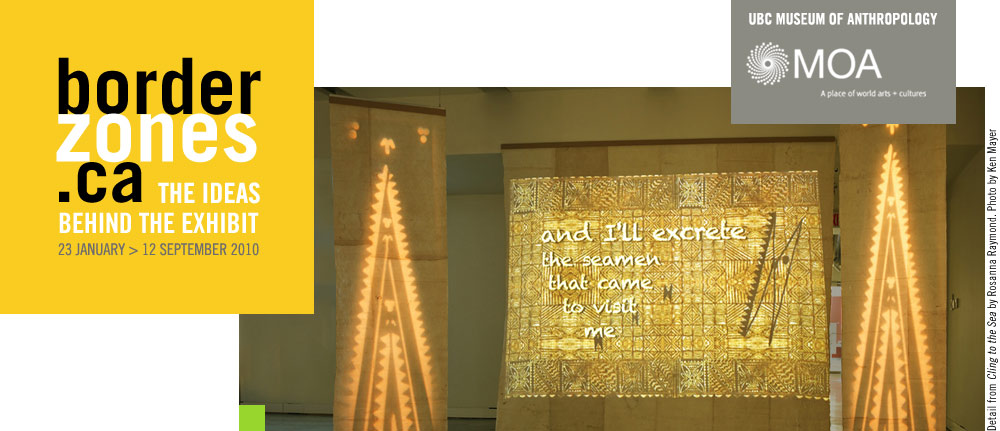
Cling to the Sea
In this work I wanted to reveal the intangible connections, hidden voices,
and shared histories contained in MOA’s collection, specifically
an upeti (Samoan pattern tablet used in bark cloth production) from the
Museum’s founding collector, Frank Burnett.
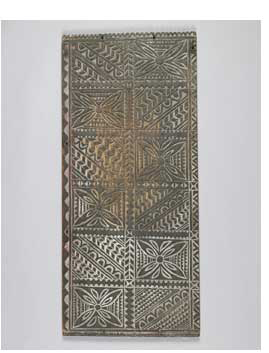
Upeti (tapa printing board), Samoan, collected by Frank Burnett
between 1895 and 1927. 76.2 cm L x 33.7 cm W. MOA object number
C5.
|
|
It was the donation of Burnett’s vast and wide ranging collections
that founded MOA. Burnett and his collections took on a new importance
to me, as this was the start of my relationship with MOA, its Pacific
collections, and its visitors. I am personally interested in the rupture
that was formed between the exchange of people after contact and what
happens to an object when it enters the realm of the museum space. I feel
the relationship has to be preserved as much as the physical object so
that future relationships can create living legacies, rather than a simple
exploration of material culture from the past.
Frank Burnett was an interesting character. He was an immigrant, farmer,
businessman, seaman, published travel writer, photographer, amateur anthropologist,
and serial collector of idols, but it wasn’t until I viewed a copy
of his personal scrapbook that I also added dusky maiden pervert and occasional
pirate to my list.
These images are not anything I hadn’t seen before, as they have
been readily available to a global public since the late 1800s, but it
certainly made me ponder Burnett’s motives when travelling to, writing
about, and photographing the many peoples of the Pacific. My first reaction
was to expose him/them…but I had to question this as well. It seemed
to me that I would just be (re)presenting the unnamed, semi-nude, dusky
maidens to the public view and there is already much written about the
gaze, the colonized body, and the use of imagery to uphold scientific
thought of the time. I did not want all this to be the focus of this particular
work… though I can’t get it out of my mind, and as I read
his books and learnt more about him, I started to engage with Frank and
the collections in a much different way.
I am interested in the unrecognised histories (constructed or factual)
that are revealed when people and objects come together. In the Pacific,
cloth is an important part of binding people together, as bark cloth has
been part of this process for untold generations. In order to keep the
legacy of Frank Burnett’s contact with the Pacific active and relevant
to the present, I wanted to establish a Va (Samoan word for space) relationship
between Frank, the collections, and myself, creating a shared space where
we all come together to reactivate, reinvigorate, retranslate, and reciprocate
in the act of creating new narratives for his collections and the museum.
Va adheres time to space. This space is not a linear space, or indeed
an empty one, but rather the ‘Va’ space is activated by people,
binding people and objects together, forming relationships and reciprocal
obligations. The ConVAsation is one aspect of the work, the ActiVAtion
is another part.
The main body of Cling to the Sea
is a poem. My next issue was how to present a poem in a gallery space
where words are not usually considered the main art form, but rather are
a practice associated with performance work and used to explain the work
to visitors.
For me the poem is just a series of words, and the ‘upeti’
just another object to be found in the holdings of the museum, until I
have activated this space through my presence. My Polynesian body is the
vessel for the ancestor, the space where the genealogical matter comes
together, binding the past with the present.
So when I meet taonga, in this case the upeti, I activate a space between
the past and the present: I enable them to be present. This in turn activates
the ‘mauri’ (the spark of life, which sustains existence and
form). It is my presence that brings the upeti, Frank, and me together,
binding us to each other, creating a living dynamic which can be then
taken out of the spatial confines of the box or case.
I am the muse
I am the dusky maiden
I am the savage
I am the ancestor
I am the upeti
I am the museum
- Rosanna Raymond
|
 |
FEATURE: Reanimation, Upgrades,
and Ancestors in the Work of Rosanne Raymond by Albert Refiti |
 |
|





























 Artist's
Statement
Artist's
Statement 




