 |
|
Once you've earned the right to stand on that podium you've got that
square metre of the world that belongs to you. What you do with
it is up to you—within limits.”
Peter Norman
|
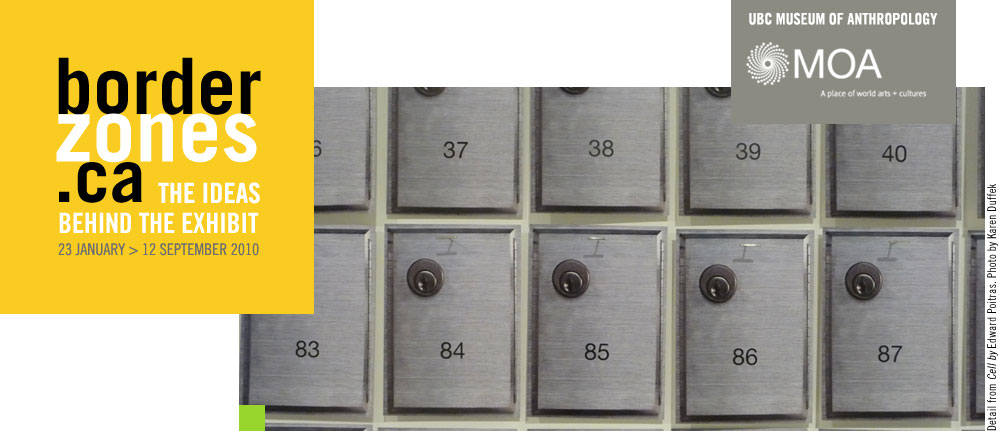
Cell
Cell is a work that was inspired by the civil rights movement,
notions of the self, and ideas of nation and community. It was inspired
by the sacrifices that individuals have made in defense of those ideas
or movements and how histories are constructed to unite a people at the
expense of the “truth.” It is about time and space, or rather
the illusion of time and space, with the idea of entanglement, and how
we are all connected beyond our ideas of separation. How we dream of unity
when we are divided and polarized by ideas of right and wrong and left
and right. How this strategy has served humanity in its survival in adverse
conditions and is hard-wired into our system. Which raises the question:
Will we ever be united at all?
Not in my lifetime, he says with a twisted smile. Coyote meanders off,
stage left.
In the first artist’s statement that I ever wrote, called Indian
Territory, I said something like “my skin is my border….”
Looking back after all these years I realize I was wrong, and that this
was a selfish notion. We are connected in many ways as individuals and
communities, yet we use division to capitalize on opportunity and to gain
an advantage for the sake of propagating the self, the state, and the
nation. We exploit others for this reason and create situations such as
war and tragedy. I want what you have and these are the justifications
for taking it. The Papal Bulls issued by the Catholic Church in 1450 and
1493 are classic examples of this justification. They say there is separation
of church and state, yet these have set a precedent for taking non-Christian
lands, such as Indian and Aboriginal lands—at least some people
were lucky to have signed treaties, thereby setting a position of sovereignty.
The reservation is a cell, yet it is sovereign territory. John Tootoosis,
an Indian elder statesman, said and believed that it is a small state,
a nation. It’s important that people think this way. This country
is a cell, this world is a cell, this galaxy is a cell—it all becomes
relative to how you look at it. In every small and large unit there is
division. It seems to be a fundamental principal of our existence, and
the dynamics of interaction are just a part of this big picture. Will
there ever be unity? Not in this reality. Maybe in death and maybe that
is why we have these apocalyptic fantasies and dreams of an end—it
may be the only way that unity will ever happen. People unite in extreme
situations where life is in the balance: us against nature, the other,
the dark, and the negative. We are small in the face of the forces of
nature. Perhaps we are hard-wired for survival. After being on this earth
a million years and witnessing the constant change from day into night,
I believe that we are conditioned and programmed by our reality to think
this way. It is a template for existence.
- Edward Poitras
|
 |
FEATURE: Lo-fi, Hi-fi,
Wi-fi: Edward Poitras and Cell by Hank Bull |
 |
|






























 Artist's
Statement
Artist's
Statement 




