 |
Wanx’id: to hide, to be hidden
The series of boxes I created for this installation, Wanx’id:
to hide, to be hidden, reflects on notions of access, the public
and the private, the sacred and the ordinary, and the tensions that exist
between different cultures’ relationships to objects and artifacts.
The highest point of tension exists when the definitions and understandings
of these ideas are challenged. My work seeks to disrupt the general viewing
experience of Western-European-based museums by rendering certain portions
of the objects inaccessible or apparently "hidden."
I saw a bentwood box in the Portland Art Museum in May, 2009: it was
painted on the interior and bare on the outside. I am still deeply intrigued
by this box. When I first saw it I considered it to be a piece that challenged
the boundaries of our understanding of Pacific Northwest Coast works.
I suspect the reason for the interior painting had to do with the purpose
of the box and the intended content. I wonder about the purpose of this,
and the metaphorical analogies that could be applied in a contemporary
context.
Recently I travelled with my cousins Mike Willie and Ryan Nicolson to
New York, Washington, and Philadelphia. We entered the archives through
heavy security. We pulled open drawers and opened boxes to view masks
and regalia. We reviewed letters and manuscripts, studying Boas and Hunt's
writing system in order to be able to understand what they had collected.
We were engaged in a dance of discovery and display, the pursuit and elusiveness
of our cultural history. I saw this act as a metaphor for the box. Both
poetic and human, if likened to the body, and social and political, if
likened to the museum or even to the "boxes" that hold our culture.
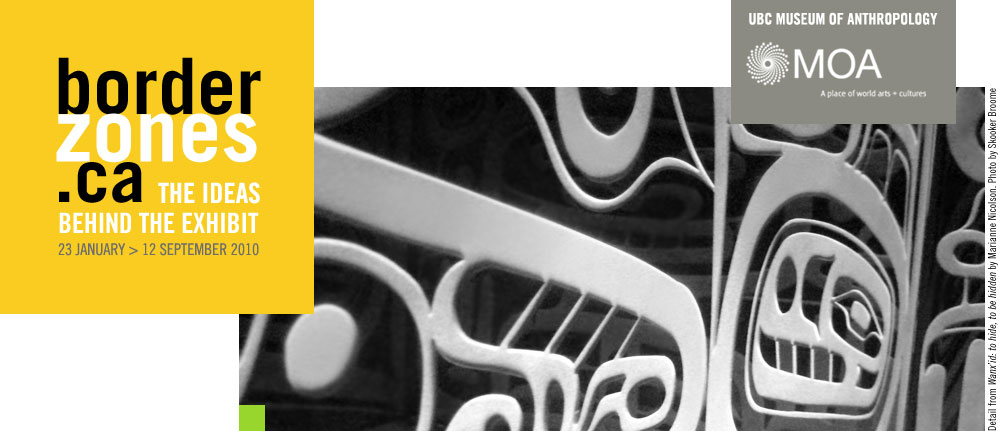
The glass boxes are blackened on the outside, mediating or prohibiting
immediate visual access. The box designs are carved into the interior
surfaces. If lit properly, the interior images faintly emerge on the outside
of the box, like shadows or ghosts. On initial viewing the designs are
only accessible if people lean over and peer into the space. This disrupts
the traditional vertical viewing experience of work in galleries, where
the viewer stands upright and looks with a horizontal gaze at work. It
requests a more physical engagement of the body.
I created the eight glass boxes to reference the display of Northwest
Coast painted cedar boxes in the Great Hall of the Museum of Anthropology,
where the bentwood containers are set. The display would, in a sense,
mimic this display and parody the attempt to renegotiate spaces, museum
displays, and cultural relationships. What to show, what to hold back,
renegotiating how we learn, the revelation of life (creativity and construction)
and the negation of death (deterioration and disappearance): all up together
on a platform for exhibition. My boxes also mimic the glass exterior of
this museum and other gallery-type spaces that exhibit Pacific Northwest
Coast works. As a whole, the installation begins to reference a series
of buildings or even the urban landscape, highlighting yet another contemporary
tension in the Indigenous experience.
I struggled to come up with the visual photographic images to place inside
each box. In the end I chose photos that had deep meaning for me. I thought
about who my audience was—and outside all of the politics around
producing Aboriginal art I thought of my family, and what our experience
is like to enter a museum such as MOA and see ourselves reflected everywhere...and
yet nowhere. I felt then what it would be like for my family and relatives
to look inside the boxes and see ourselves, our history, our land, our
art...all as one piece... as one expression.
The photographic images reflect the Dzawada’enuxw people and their
homeland of Kingcome Inlet (Gwa’yi). Each of the people pictured
represents the living knowledge that today we seek from institutions.
In the past, without colonialism, we would have learned this information
about ourselves directly from our ancestors. Our ancestors pictured here
in the 1930s embodied “living museums of information.” A tenuous
link: I knew many of the children pictured here only as elders. Today,
only a few remain. What they inherently knew is now reflected in the glass
cases and archives of museums across North America and Europe. All of
it is fragmented and disparate. My generation is attempting to bring these
things together to make them whole again—perhaps to make ourselves
whole again.
My original idea for the glass boxes came out of a global conceptual
contemporary critique. But the photographs moved the work beyond that
framework and made it "about us" as well as "for us."
For "me", really.
- Marianne Nicolson
|
 |
FEATURE: Our
Art is our Life: The Power of Marianne Nicolson's Work by Gerald
Taiaiake Alfred |
 |
|




























 Artist's
Statement
Artist's
Statement 




