 |
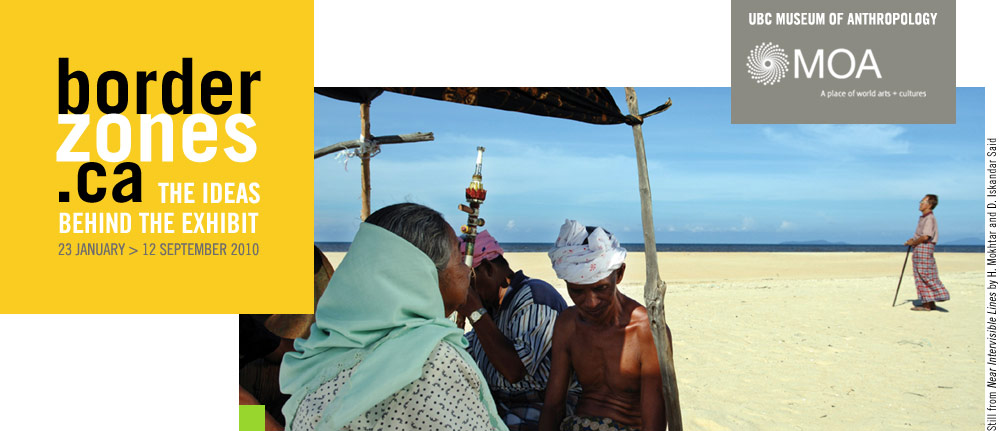
Near Intervisible Lines
We travelled up to Setiu, a district made up of coastal lagoons and tidal
black-water forests, led there by an implicit sense of nostalgia—
yet he had only ever passed through, and I had never been. We went as
if to find a place that we had left behind, knowing the impossibility.
When we arrived, we saw that so had progress: the natural scenery encroached
upon by fish farms, palm oil plantations and newer houses fitted with
satellite television; here the tidemarks are a long strip of driftwood
and litter.
We drew guidelines for ourselves, lightly, as one might do in pencil:
we would drive, and along the way we would stop to study the terrain,
speak to people (most of them old); and, from these points of departure,
traverse beyond a visual encounter with the landscape towards an understanding
of it as an analytical concept.
We found ourselves on a tract of sand, a spit located in an estuary at
the furthest intersection point between the river and the South China
Sea. There had once been a settlement here but erosion had forced its
inhabitants away and erased all visible markers. Its existence would have
remained hidden to us had it not been charted by an early land survey
or if no one had remembered. That is to say: there is, as always, the
landscape that one first sees, then another layered beneath it, still
resonant, perhaps, but inaccessible, structured less by matter than by
history.
We realized that we now stood before an expanse that was characterized
less by its emptiness than by its fullness. A rich zone, crisscrossed
with invisible lines. Delineations which could be seen as serving to create
not only a foreground and background, contours and numbered lots, but
also to engender a series of oppositional and yet inter-related forms
of experience: (between an actuality and a potentiality, an inside and
an outside, a past and future): abstractions that reflected the shifting
and permeable tensions that function at the very foundations of the concept
of landscape itself.
We continued to take in the prospect. We broadened our view. And, perceived
in this manner what lay before us now appeared as being not so much a
static construct, a framing device, but as a site for a set of operations
that were capable—through the filter of the viewing subject—of
generating and mediating a whole set of meanings and possibilities. In
other words, the landscape that we had come to contemplate emerged as
being a mutable screen between matter and subjectivity. Situated before
and in relation to it we recognized ourselves as being spectators with
the capacity to picture and articulate both its substance and productivities.
We knew where we were. Or so we thought. We could carry on this path,
if only for a while. That is, until such a time when, looking at the landscape,
a sudden reversal would occur and the scene would revert back to its raw
state: then and there, sand, sea and sky would abandon their material
outlines and dissolve into elements that were impervious to order. All
at once the arrangement of what we had rendered and described collapsed
in upon itself. And, it was as we stood before this dissolution that we
slipped, headlong. We attempted to speak as we fell, but faltered and
produced what was barely a sound, as if uttered in a voice that wanted
to lose itself to the wind.
We are foolhardy travelers. To think that, out of all of this, and more,
we could even have thought of making a film.
- Hayati Mokhtar and Dain Iskandar Said
|
 |
FEATURE: Horizons:
Drawing the Line by Loretta Todd |
 |
|






























 Artists' Statement




