|
|
|

|
September 12, 2010 The pile of shoes by the meeting-room door was a clear signal that something about this space had changed—at least temporarily.
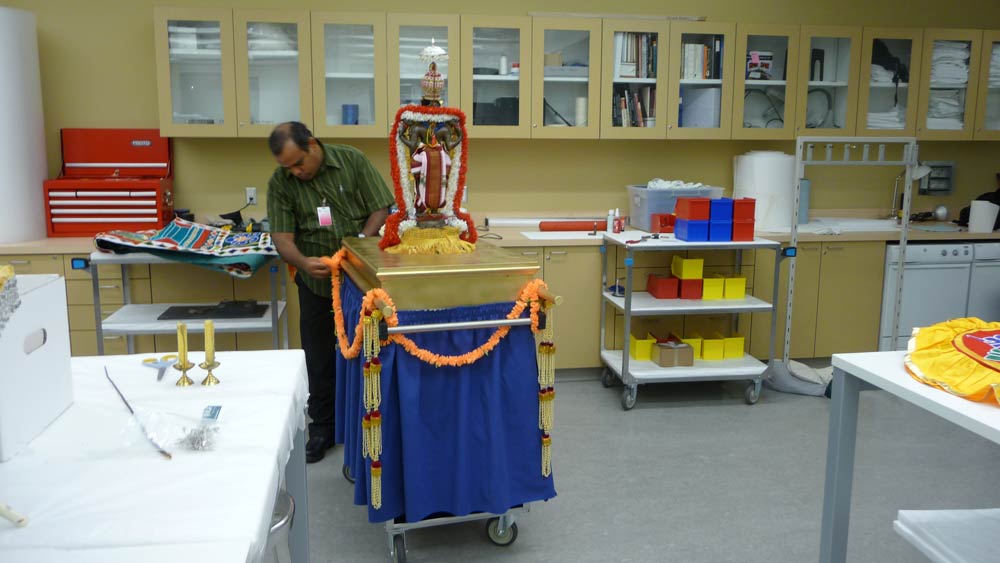
Prabakar Visvanath, the local Hindu priest who had worked with museum staff to create Abishekam for the Border Zones show, had just wheeled MOA’s bronze Vishnu figure into the room in MOA’s office area. With this act, Room 219A became a sacred space, and the final preparations for a public Vishnu procession could begin. The figure, a finely cast bronze artifact at least a century old, was originally created as an utsava murti (festival image), meant to be taken out of the temple among the worshippers. Today’s event was going to be the first such outing for MOA’s Vishnu since it was acquired 25 years ago. The procession was billed as a continuation of the ritual documented in Abishekam, in which the continuing “life” of an artifact is performed through contemporary ritual and connection with the local community. Prabakar had already decorated the museum’s stainless-steel trolley to transform it into a ratha, or chariot. He had prepared and dressed the figure—now securely positioned on the cart—with rich cloths, garlands, and jewels, so that it was no longer an artifact to contemplate as sculpture, but a sacred vessel for the Vishnu deity to enter and perhaps gaze upon the worshippers. But just as the abishekam confronts museum definitions of object care, ritual doesn’t always fit within museum timetables or expectations of “performance.” The chanters were late. And once they arrived, ritual protocol took precedence over entertainment. An order of events determined by the spiritual leaders needed to take place out of the public eye, within the threshold marked by the shoes. The scheduled start time of 11:00 a.m. had come and gone before chanting of the Sahasranaama—the 1000 names of Lord Vishnu—finally began. Inside the room, we stood and listened; outside, an announcement of a further delay was made to the waiting audience. Museum staff furtively checked their watches; the chanting of names continued, rhythmically, peacefully.
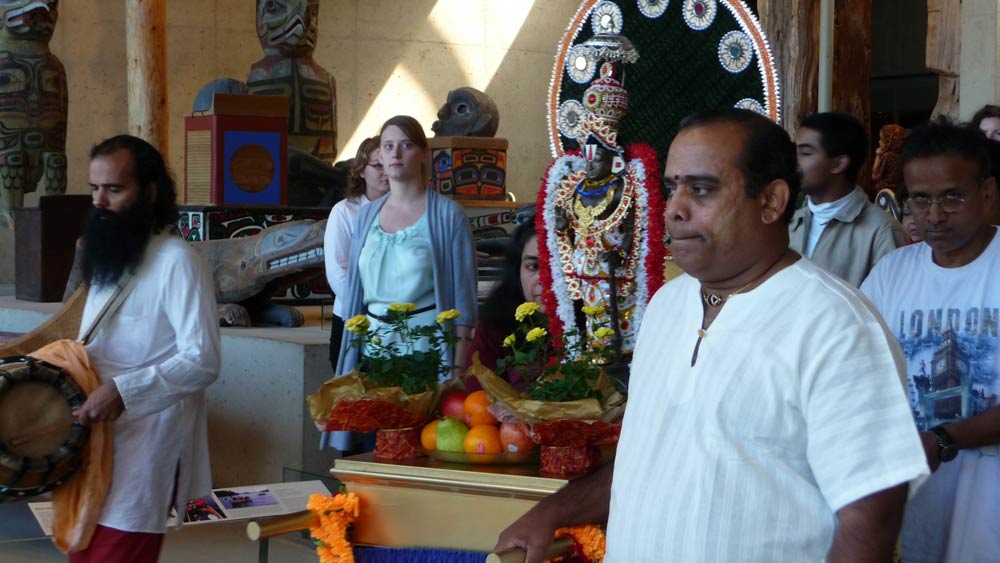
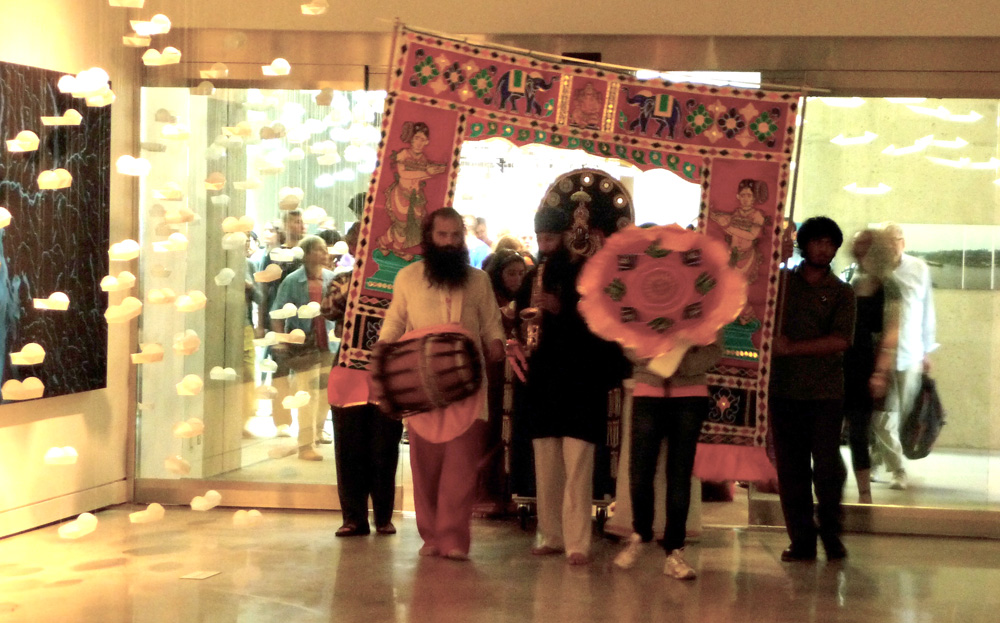
Then, with the vibrant sounds of drumming, fusion-jazz saxophone, recorded sitar, and singing, the procession began. Some museum visitors had come especially to witness this event; others were startled to see the cacophonous procession weave its way among the totem poles. The chariot and stream of worshippers, museum staff, and primarily non-Hindu visitors navigated a circuitous route through the museum’s Great Hall and Border Zones. In a confluence of past and present, both live and mediated, the group passed in front of the Abishekam video-installation—the priest and the image of Vishnu captured at once on video and in silhouette—before heading out of the gallery again, past Bill Reid’s Raven peering quizzically at the goings-on below, and ultimately back to the sanctum of Room 219A. The procession made clear that it’s not only the physical object that is our focus—even in an exhibition of contemporary art, or in a museum of cultural treasures from around the world. It is the object’s place within changing, moving, uprooted, re-routed, and perhaps even unrelated cultures that troubles our assumptions about borders and how they separate us in time and space.
For eight months—the duration of Border Zones—the video of the abishekam ritual has played in an endless loop: again and again we could witness the milk and fruit poured over the bronze, watch the figure being wrapped and dressed, hear the ringing bells. Again and again we could be surprised, even shocked, by this gloves-off transgression of museum practice within its walls. Through the procession, we could also witness how participants from Vancouver’s Hindu community enfolded this apparently alienated, historical bronze into their own contemporary practice. “I didn’t know I would receive darshan today,” one of the women confided, referring to the blessing she had experienced. The group talked about “next time”—the possibility of holding a Vishnu procession again in the coming year, with more community members, and how it might be enhanced and expanded. Although this procession is over, the Vishnu figure is back in the display of South Asian artifacts, and Border Zones is closed, a relationship has been set in motion. For a moment, we inhabited a space between museum and temple, between seeing and being seen, between cultural practice and staged performance, between the impossibility of translation and a shared experience. To be continued.
|
 |
 |
|
|
|
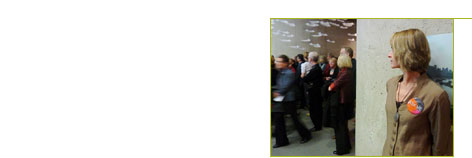
June 29, 2010 Last January, during the opening festivities of Border Zones and the Museum of Anthropology’s new Multiversity Galleries, a visitor came up to me as I stood in the exhibition space. Noticing the enormous ASK ME button I was wearing, she did just that.
“Where is the museum? This isn’t the museum, right?” She was looking at the works surrounding her—projections of words on tapa-cloth patterns; sounds and images accompanying the ritual bathing of a bronze Vishnu; a wall-long video of a Malaysian landscape—none of it apparently recognizable as anthropology or artifact. She didn’t look convinced as I explained that the main idea behind the show was to bring forward, through the work of contemporary artists from around the world, the very questions that MOA and its audiences and communities are grappling with: how we understand the concepts of “culture” and “cultural difference” now, in the 21st century. But it was Gu Xiong’s installation, Becoming Rivers, with its evocative representation of his own experience as a migrant coming from China to Canada, that helped her to understand the connection. Her eyes lit up as she began to relate her own history to this story, and she hurried off to explain the work to her husband and give it a closer look. Since then, I’ve had numerous encounters that insist on an art-gallery/anthropology-museum divide—a chasm I had mistakenly assumed has long been bridged, if not closed, over the past few decades of border-crossing art making, cultural practices, and exhibitions. Others, such as a class of studio-art majors who travelled to MOA from Washington State, were surprised with the debate, thinking it self evident that contemporary art must have a place in a museum that examines the cultural expressions of living peoples around the world. In her review of Border Zones, artist Dana Claxton asks the apparently still-burning question, Should anthropology museums “meddle” in contemporary art? She wonders if “the stigma of the anthro-ethno gaze” can ever be shed at these sites. And she’s right: museums, especially those in North America and New Zealand, have been working with originating communities to radically change their approaches to representing “cultures” and cultural knowledge, and to do so collaboratively. As a result, can museums afford not to meddle—not to question the hierarchies established in art institutions as well—and strive to consider community voices, ritual, sculpture, and new media on a shared terrain, as contemporary cultural practice? I’m left wondering about institutional divides and how they echo many of the cultural borders we experience in the world today. Contrary to what I was assuming, that divide remains an uncertain kind of space: a place of conflict and transformation, creativity and limitation. How and why is this boundary made? Who does it serve, and who needs to challenge it? As an exhibition, does Border Zones itself exist in the space between borders, just like the art it presents?
|
|
|
|
|
June 1, 2010 When Musqueam elder Larry Grant stands before an audience at the Museum of Anthropology (MOA) to open an exhibition like Border Zones, he welcomes the guests in his Hunquminum language. He explains who he is by invoking the names of his ancestors. He describes the land on which the audience and the museum stand as the traditional, unceded territory of the indigenous Musqueam people. He also tells how the Musqueam both defended this land from Aboriginal and European invaders while welcoming those people who came in peace. Then he offers an English translation. Larry Grant’s words point to a boundary—and an opening through it. They speak of a cultural and political space that needs to be protected and not available for ready translation, while creating another space in which an engagement must also occur. And they help us to notice where we’re standing: this in-between place of the museum on Aboriginal land, where we have an opportunity to consider how different people, ways of knowing the world, and human divisions and connections come into play. |
|
|
|
|
|
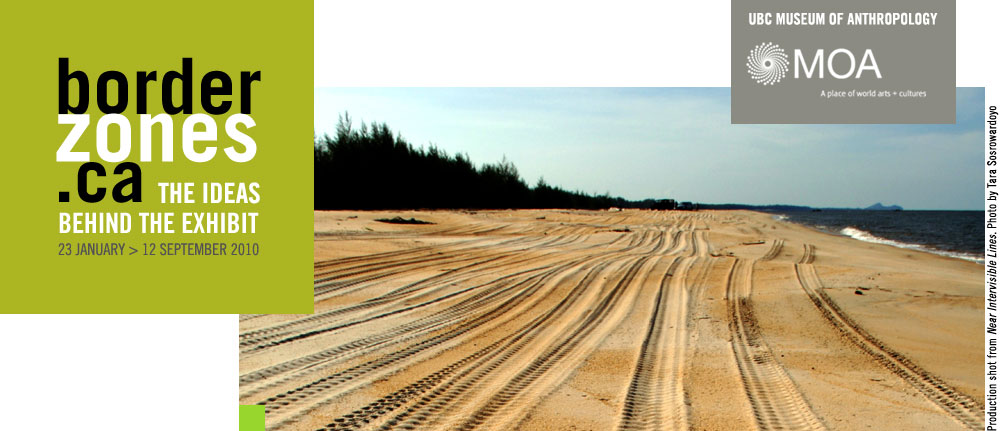
Now that Border Zones has been open for four months—and is continuing for several more—I’m eager to pause and reflect on how the exhibition was developed and continues to evolve, and to take a look at some of the questions and debates that it is provoking. What is the place of cultural boundaries in the 21st century? Should they be dismantled, or strengthened? Who decides? What roles do museums play in the construction of borders and difference? And does contemporary art have a voice in these debates? One of my goals in organizing Border Zones was to raise questions. Museums have a long history of providing answers, or of masking the arguments and tensions that underlie its representations of history and cultural identity. But in recent decades museums have also been loudly challenged by the originating communities whose heritage is on display. This has led MOA, and many other institutions, to work toward collaborative relationships with First Nations and other cultural communities, and to make more visible the negotiations and conversations behind our work that are often hidden from public view. I asked the artists in Border Zones to describe their work in terms of a question it asks. Gu Xiong answered, “How can different cultures intertwine their personal journeys, and move together into a new space?” Dain Iskandar Said teases us with his response: “As you think of these questions about culture and place, does it disturb and raise feelings that are familiar and provoke you, or do you continue with your duck noodles (or steak and mash) and think about killing your neighbours because you can't stand the smell of curry coming from their window?” These are useful provocations to help us think about borders in our own lives, beyond the walls of the exhibit or the museum. I’ve also been listening to the conversations that, it seems to me, are going on among the artworks themselves: between the voices telling personal stories in John Wynne’s Anspayaxw, and the memory objects displayed inside T. Shanaathanan’s 300 bottles; between the childhood faces of Marianne Nicolson’s elders and great uncles peering upward from her glass boxes, and the forms of containment expressed in Edward Poitras’s Cell. In Hayati Mokhtar and Dain Said’s Intervisible Lines, between the histories layered under the shifting sands, and the thunderous bite of metal jaws on discarded goods in the landscape of Tania Mouraud’s Face to Face. Gu Xiong’s 1500 boats float through the museum walls, while the Vishnu image in Prabakar Visvanath’s Abishekam shifts between artifact and sacred entity, and Rosanna Raymond’s upeti invigorates a space between collector, museum, and living communities. |
|
|
|
|
|
Those conversations weren’t necessarily anticipated, but are emerging over time, and so point to the possibility that an exhibition is less of a finished product than a conversation in process. In the ensuing weeks, this page will become a kind of “Curator’s Journal” about Border Zones: a behind-the-scenes look at how the show was put together, reflections on broader issues of boundaries and translations and how these have come to be performed at the museum, and ongoing dialogues between the art works, the museum, and you, our viewers and readers. I welcome your ideas and questions.
Photo of Karen Duffek by James Clifford |
|
 |
 |
 |
 |
 |
 |
 |